Sunday, November 05, 2006

Bloggers privacy expectations and attitudes

The number of blog writers and readers has grown enormously in the last few years. Moreover, blogs are permeating most niches of social life, addressing a range of topics from scholarly and political issues to family and children's daily lives.

Blogging has the power to affect not only the lives of bloggers themselves but also of the people, companies, and products that are "blogged." For example, accounts of bloggers hurting friends' feelings or losing their jobs because of materials published on their sites are becoming more frequent. Therefore, it is important to understand how accountability and privacy expectations function in this emergent arena.

What this study is about…?

Karen Mc Cullagh is conducting an online survey to explore the privacy attitudes and expectations of bloggers as part of her PhD research, which is sponsored by the ESRC and Office of the Information Commissioner, UK.

What kinds of questions are asked…?

If you participate you will be asked to answer questions anonymously about your blogging practices and your expectations of privacy when publishing online. The survey focuses on four areas:

1. Blog content
What kind of content do bloggers publish?
Do bloggers seek permission to post photo’s of others or information about other’s lives.

2. Privacy and Identity management
Do bloggers identify themselves on their blogs?
Do bloggers identify others on their blogs?
Is identification dependent on content? (i.e., do bloggers refrain from revealing people's identities when writing about sensitive matters?)

3. Audience and control features
Do authors limit who has access to their blog posts?
Do bloggers know their readers are?

4. Privacy attitudes and expectations – legal implications

What information do people consider to be private?

What types of information do people consider to be sensitive?

Are some types of information too personal/private to publish on a blog?

Are authors getting in trouble—legally or personally—because of materials published on their blogs?

What will happen your answers...?

All answers will be stored and analysed on a confidential basis.

The responses will be used to inform academic and policy discussions on blogging practices and attitudes towards privacy.

Link to the survey:

Please take part in the survey: http://www.ccsr.ac.uk/privacysurvey/

Finally, could you please encourage other bloggers to participate in the study.

It takes less than 5 minutes to complete the survey!

Further information:

For further information on my research please visit

http://www.ccsr.ac.uk/staff/km.htm or, email:

Karen.mccullagh@postgrad.manchester.ac.uk

By their very nature, blogs raise a number of privacy issues. On the one hand, they are persistent and cumulative. At the same time, they are easy to produce and disseminate, resulting in large amounts of sometimes personal information being broadcast across the Internet

Thursday, November 02, 2006

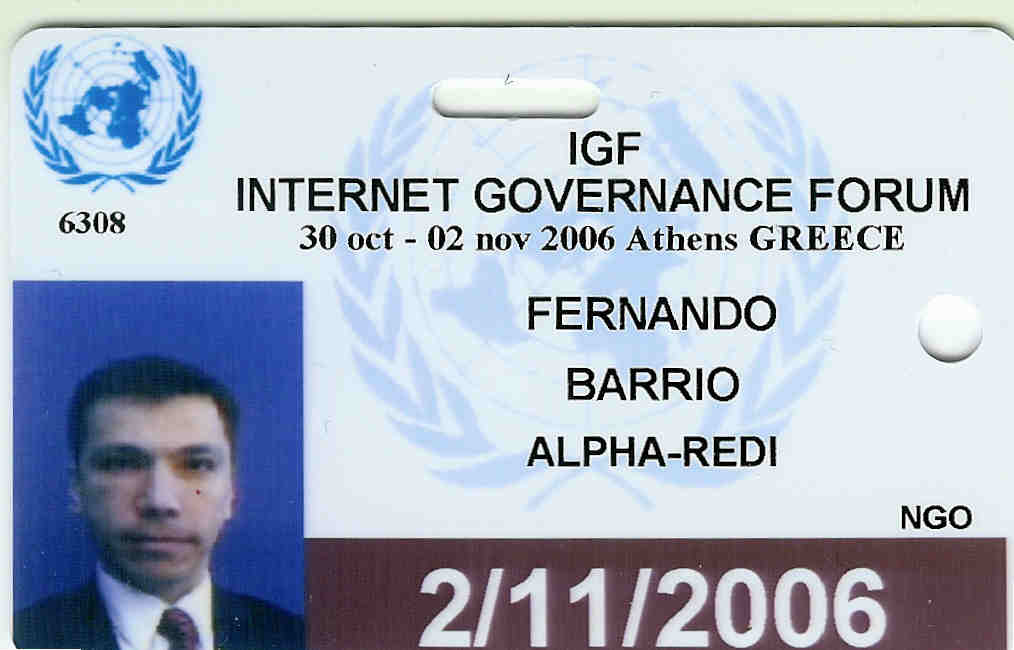
IGF Workshop on Building Local Legal Capacity on Internet Governance


As explained in the previous post, the workshop on legal aspects of Internet Governance within the Internet Governance Forum Greece 2006 was very successful and it highlighted the fact that regardless technical and standards agreements, Internet Governance takes place through a set of regulations, most of which are implemented by laws. The seminar was jointly organized by David Satola, Senior Counsel at the Legal Vice Presidency of the World Bank, Alfa-Redi, the Cyberspace Law Committee at the Business Law Section of American Bar Association, Diplo Foundation, the Global Internet Policy Initiative, the Internet Society of Bulgaria, and the Science and Technology Law Section of the American Bar Association.
The topic of the workshop was capacity building on legal aspects of Internet Governance and the relation between international and domestic law in this process. After a brief introduction by David Satola (another congratulations and big thanks for the organization of the workshop), the presentations were started by Jim Dempsey, from the Center for Democracy and Technology, who explained what the legal issues associated with Internet Governance were and what institutions were dealing with them at different levels. His matrix relating different levels of Internet Governance, from the individual to the international, with the institutional standing of the players was a very useful tool to better understand all the following talks. He was followed by Hanne Sophie Greve, Judge of the Court of Appeal of Norway (very difficult to find public information in Norway's sites, as the Judge's link or biography), who explained the basic concepts of international law and European Human Rights law, to then relate them to their impact on domestic legal regulation and the need of following those principles when addressing both Internet Governance and the domestic capacity building related to it.
The third speaker was Kristine Dorrain (National Arbitration Forum) and she focused on the Uniform Domain-name Dispute-Resolution Policy and how it impacted Internet Governance at domestic level. Her presentation went on to show some examples of the use of that process and questioned the reasons for national level adoption and usage of them. The first part of the panel (due to the number of speakers it was divided in two parts) ended with a clear and concise explanation from Fred Tipson, Microsoft, about the need of multistakeholder participation on the policy development processes. It was important because his presentation seemed to emphasise that need, not only based on the assurance that all the views and interests were protected and taken into account, but also on the fact that “multistakeholderisation” (yes, I just made it up) was vital to the process due to complementarity of expertises and knowledge.
The second phase of the panel was opened by Veni Markovsky, from ISOC Bulgaria, who explained how, following the Bulgarian case, the relation between international and national Internet Governance processes could be solved by solving first the domestic issues. During the questions’ time, Veni repeated that his country’s case showed that it was necessary to first put the house in order before engaging with the neighbours, and that that could be achieved with a bottom-up approach. I, representing Alfa-Redi, followed with a short presentation on the need to incorporate intellectual property rights into the Internet Governance’s discussion because, even the advances in connectivity had been important, those advances contrasted the proprietization of knowledge and information accompanying the digital revolution. The problem, I argued, was located in how international norms had been used to impose changes on intellectual property domestic legislation tending to the concentration of ownership of content and how it seemed that until now capacity building had been used to domesticate domestic actors instead of to build the capacity to create its own set of rules in accordance with international law (due to time constrains, the original idea of introducing eLac 2007 was abandoned, but Erick Iriarte explained briefly about it from the floor). Peng Hwa Ang, from the Nanyang Technological University, followed explaining that in Singapore, the process of Internet Governance was addressed following a top-down approach, which resulted in a high level of trust, what can be easily related to the very high penetration rate that Internet had in his country. He also highlighted the problems of legislation being enacted too early and the need of reforms in some areas.
The two final presentations have in common the issue of coaching and knowledge transfer as important aspect of capacity building in Internet Governance. Pierre Dandjinou, of the United Nations Development Porgramme, referred to the role of national institutions in the development of national legal frameworks and how certain limitations could be overcame with advocacy, coaching and knowledge sharing at both domestic and international level. Finally, Jovan Kurbalija (Diplos Foundation) explained in detail the process of capacity building and how his organization was dealing with it. His presentation emphasised the need of capacity building for different actors of the policy making process and the necessity of tailoring programs for different situations, and expanded in the issue of “multistakeholderism” (another verbal creation) as “expertise-sharing” rather than “interest-protecting”.
As I said yesterday, it can be seen as the beginning of the beginning and I hope that we all have time to put this into paper to have soon a publication on the topic.

IGF 2006 Legal Aspects Seminar

The seminar on legal aspects, organized by David Satola from the Legal Vice Presidency of the World Bank, was more than a great success. The place was literally packed and there were people standing and sitting on the floor. Then, there was also the abundance in quantity and quality of speakers: nine speakers and David as moderator (with me as being the exception in quality that confirms the rule :) It was quite clear that this morning panel's was not and end or the beginning of the end but the begining of the begining (a little misquote of Churchill, but he wouldn't mind).
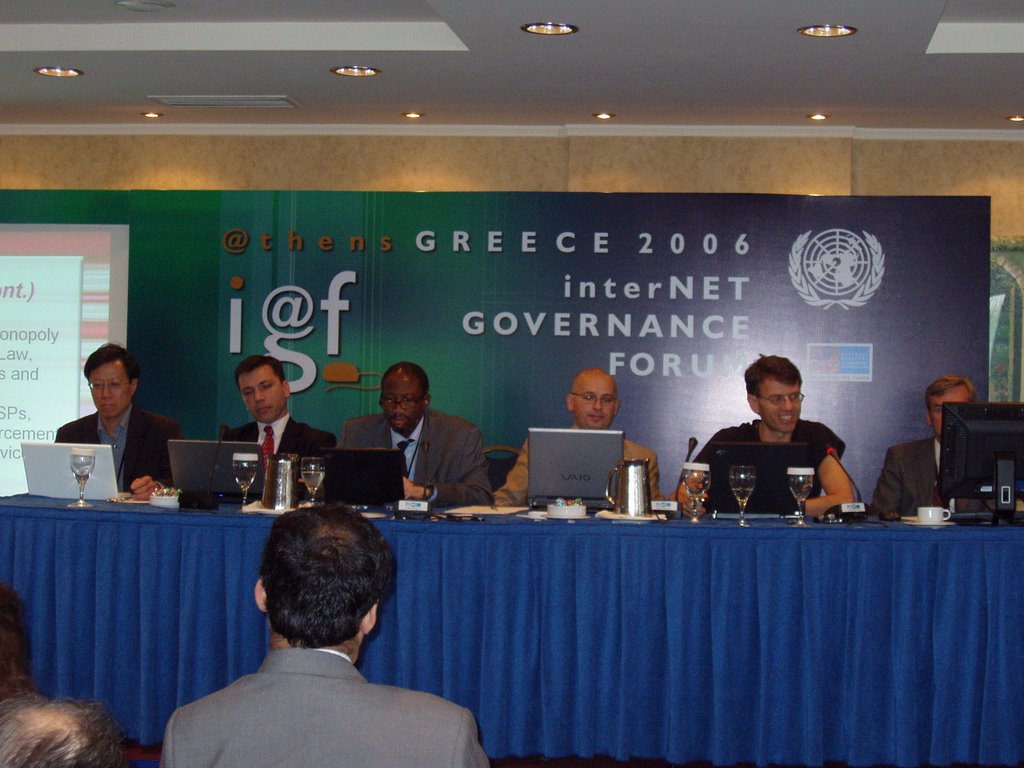
Following there is a photo of the second part of the panel (and my face, second from your left, does not look swolen, it is swolen due to been bitten by a bug in Paris)

Wednesday, November 01, 2006

From the IGF in Athens

I am participating in the Internet Governance Forum in Greece, as part of the seminar on legal issues, and tonight I will post a summary of the session.

Tuesday, October 24, 2006

Call for Papers Globalization, Technology and Development


Call for papers:
Globalization, Technology and Development

The International Political Association Research Committees 04 on Public Bureaucracies in Developing Societies, 35 on Technology and Development (IPSA RC04 and RC35) and Webster University invite submission of papers for the Conference “Globalization, Technology and Development” to take place in St Louis, Missouri, USA, during 3, 4 and 5 of April 2007. This conference is part of the IPSA RC04 and RC35 Regional Meetings and the 2006/2007 Webster University Des Lee Visiting Lectureship for Global Awareness and it seeks to address the relation between globalization and technology and how their dynamic and dialectic relation impacts on development. The conference is co-chaired by Dr. Renu Khator, Provost of the South Florida University at Tampa and Chair of the IPSA RC04, Professor Dhirendra Kumar Vajpeyi, Professor of Political Science at the University of Northern Iowa and Chair of IPSA RC35, Professor Allan MacNeill, Director of the Department of Political Science and International Relations of Webster University, and Dr. Fernando Barrio, 2006/2007 Webster University Des Lee Visiting Lecturer for Global Awareness.

While the methodology is open, it is expected that the papers would be based on theoretical and empirical work leading to the development of grounded theory, as well as more policy orientated studies which feed directly into the policy making process. They would normally be built on a multi or inter-disciplinary approach.

The conference will likely include the following non-exclusive issues:

- Globalization of Intellectual Property rights, technology and development
- Globalization of technology and its impact on the Earth
- Innovation policy, technology and development
- International relations of technology transfers
- New technologies and the Digital Divide
- New technologies, communications policies and development
- Technology and human security

Submissions in the form of an abstract should be e-mailed to Dr. Fernando Barrio f.barrio@londonmet.ac.uk and it must be received by January 18th, 2007. Confirmation of acceptance will be communicated by February 9th, 2007. Papers and abstracts can be written in English, French or Spanish, but the presentations are expected to be delivered in English. Please submit your abstract of up to 300 words in .doc, .rtf or .pdf format, and include the following data:

Last name(s):
Given name(s):
Mailing address:
City:
State or Province:
Post Code:
Country:
Email address:
Affiliation:

Co-Author(s):

Conferencia Globalizacion, Tecnologia y Desarrollo/Globalisation, technologie et développement

Español/Francais

Solicitud de Ponencias:
Globalización, Tecnología y Desarrollo


Los Comités de Investigación 04 en Burocracias Publicas in Sociedades en Desarrollo y 35 en Tecnología y Desarrollo de la Asociación Internacional de Ciencia Política (IPSA RC35) y la Universidad Webster invitan a enviar propuestas de ponencias a ser presentadas en el Congreso Globalización, Tecnología y Desarrollo que tendrá lugar en la ciudad de St. Louis, Missouri, Estados Unidos de América, los días 3, 4 y 5 de Abril del 2007. Este congreso es parte del IPSA RC35 Encuentro Regional y la Cátedra Des Lee para la Conciencia Global 2006-2007 de la Universidad Webster, y busca referirse a la relación entre globalización y tecnología y a cómo esa relación dinámica y dialéctica impacta en el desarrollo. Los co-presidentes del congreso son la Dra. Renu Khator, Principal de la Universidad del Sur de Florida y Presidenta dek IPSA RC04, el Profesor Dhirendra Kumar Vajpeyi, Profesor de Ciencia Politica en la Universidad del Norte de Iowa y Presidente del IPSA RC35, el Profesor Allan MacNeill, Director de Departamento de Ciencia Política y Relaciones Internacionales de la Universidad Webster, y el Dr. Fernando Barrio, Catedrático Visitante Des Lee para la Conciencia Global 2006-2007 de la Universidad Webster.

Mientras la metodología es abierta, se espera que las ponencias estén basadas en estudios teóricos y empíricos que lleven al desarrollo de teorías fundamentadas, al igual que estudios más orientados hacia políticas que alimenten directamente el proceso decisorio. Estas estarán normalmente construidas desde un enfoque inter o multidisciplinario.

El congreso incluirá, entre otros, los siguientes temas:

- Globalización de los derechos de propiedad intelectual, tecnología y desarrollo

- Globalización tecnológica y su impacto sobre la Tierra

- Políticas de innovación, tecnología y desarrollo

- Las relaciones internacionales de las transferencias de tecnología

- Las nuevas tecnologías y la brecha digital

- Nuevas tecnologías, políticas de comunicación y desarrollo

- Tecnología y seguridad humana

Las propuestas, en forma de resumen, deberán ser enviadas por correo electrónico al Dr. Fernando Barrio, f.barrio@londonmet.ac.uk, y ser recibidas hasta el 18 de Enero del 2007. Las aceptaciones serán comunicadas hasta el 9 de Febrero del 2007.

Tanto los resúmenes como las ponencias podrán ser escritos en español, francés o inglés, pero las presentaciones deberán ser hechas en inglés. Por favor envíe el resumen de su ponencia, hasta 300 palabras, en los formatos .doc, .rtf o .pdf, incluyendo los siguientes datos:

Apellido(s):

Nombre(s):

Dirección para correspondencia:

Ciudad:

Estado o Provincia:

Código Postal:

País:

Correo electrónico:

Afiliación Institucional:

Coautor(es):


Appel pour des rapports

Globalisation, technologie et développement

Le comité de recherches sur Bureaucraties Publiques dans les Sociétés en Développement RC04, le comite de recherches sur la Technologie et le Développement 35 de l’Association Internationale de Science Politique (AISP RC04 et RC35) et l'Université de Webster invitent la soumission des monographies pour la conférence "Globalisation, Technologie et Développement" qui aura lieu à St Louis, Missouri, aux États-unis, entre le 3 et le 5 avril 2007. Cette conférence fait partie de las réunions régionales d'AISP RC04 et RC35 et le 2006/2007 Des Lee Visitant Professorat pour la Conscience Globale de l’Université de Webster et cherche à s’adresser à la relation entre la globalisation et la technologie, et de la façon dont comment leur relation dynamique et réciproque porte sur le développement. La conférence est coprésidée par la Dr Renu Khator, Principal de l’Université de la Floride du Sud et Président d’AISP RC04, le professeur Dhirendra Kumar Vajpeyi, professeur de science politique à l'Université de l’Iowa du Nordique et Président d'AISP RC35, le professeur Allan H. MacNeill, directeur du département de la Science Politique et des Relations Internationales de l’Université de Webster, et le Dr Fernando Barrio, 2006/2007 Des Lee professeur Visitant pour la Conscience Globale de l’Université de Webster.

Tandis que la méthodologie est ouverte, on s'attend à ce que les articles soient basés sur la recherche théorique et empirique menant au développement de la théorie fondée, aussi bien que par les études de politiques orientées qui alimentent directement dans le processus de prise de décision politique. Ils seraient normalement construits sur l'approche multidisciplinaire ou interdisciplinaire.

La conférence inclura entre autre les sujets suivants :

- la globalisation des droites de propriété intellectuelle, technologie et développement

- la globalisation de technologie et son rapport avec le monde

- la politique d'innovation, technologie et développement

- les relations internationales des transferts de technologie

- les nouvelles technologies et la fracture numérique

- les nouvelles technologies, politiques de communications et de développement

- la technologie et la sécurité humaine

Les soumissions sous forme abstraites devraient être expédiées au Dr Fernando Barrio f.barrio@londonmet.ac.uk et devraient reçu au plus tard le 18 janvier 2007. La confirmation de l'acceptation sera communiquée le 9 février 2007. Les rapports et les résumés peuvent être écrits en anglais, français ou espagnol, mais les présentations devraient être communiquées en anglais.

Veuillez soumettre votre résume à au moins 300 mots dans le format de doc, de rtf ou de pdf, en incluant les données suivantes :

Prénom(s) :

Nom(s) :

Adresse:

Ville :

État ou province :

Code Postal :

Pays :

Email :

Affiliation :

Coauteur(s)

Monday, October 23, 2006

Want money? Sue Google?

The New York Times has a good analysis of the legal issues facing Google and some reflections made over that. It also, unsurprisingly, refers to the possibility of being sued after their YouTube purchase, but it seems that they agree with what I said several times about the unlikehood of being found liable for copyright infringment. As explained in the NYT article

Along with YouTube’s 34 million viewers, Google will inherit a lawsuit filed last summer against the company. Robert Tur, who owns a video from the 1992 riots in Los Angeles that shows a trucker being beaten by rioters, is suing YouTube, accusing it of copyright infringement. “Clearly, we investigated that whole issue,” said David C. Drummond, Google’s general counsel and senior vice president of corporate development. Mr. Drummond pointed to the “safe harbor” provision of the 1998 Digital Millennium Copyright Act. A number of courts have held that under this provision, Web sites are not liable for copyrighted content posted by users, as long as they promptly remove it when it is pointed out to them. “We rely on the same safe harbor that YouTube relies on, so we’re fairly familiar with the issues,” Mr. Drummond said. “If you look at it, it’s somewhat illustrative of the kinds of lawsuits we face.”

The same should apply in UK under the Electronic Commerce Directive 2000 and the Electronic Commerce (EC Directive) Regulations 2002 art. 19. If any judge decides otherwise, I think that eBay will be in far bigger trouble due to the massive trademark infringement that happens in its site, for which in addition eBay gets a percentage of the sale of the infringing goods...

Microsoft and security: an impossible marriage?


During the last month's VI World Conference of Computer Law, Lilian Edwards gave a very insightful talk about the dangers possed by cyberthreats, which was followed by a discussion about what to do in that respect. Most participants favored some sort of regulation, altough there was no consensus about what type of it. The argument of imposing either civil or criminal liability into the software producers hit the argument of the complexity of their product and the impossibility of guaranteeing a fault-free software. But, for how long? It could be argued that at least there should be some sort of regulation impossing obligations to vertify that the proper care and skills are used. The obligation to provide the service with proper care and skills already exists in the English Supply of Goods and Services Act 1982 but it seems that there is a further need to certify it.
This week Microsoft released its new Internet Explorer version 7, with the motto "you wanted it easier and more secure" and today a flaw, a serious flaw, was already discovered. It is important to note that Microsoft threw a party in the Hack in the Box meeting in Malaysia to get help from the world's hackers to sort out its security problems but, according to The Tech Age "[a]n Internet Explorer 7 flaw, found just hours after the browser's launch, could result in sensitive data such as your internet banking details falling into the hands of criminals".
The topic of Internet personal security is now under the consideration of the UK's House of Lords and it seems that some legislative action might be proposed...will that be enough?

Friday, October 20, 2006

Report Internet in Argentina 2005/2006

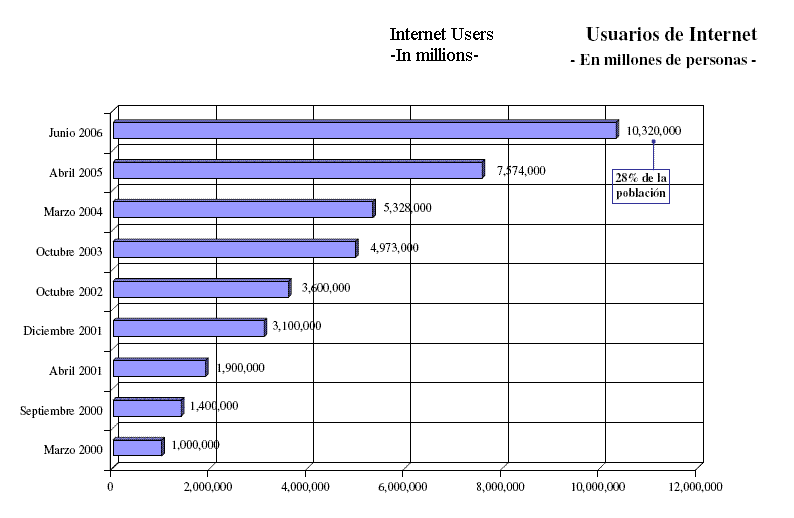
The Argentine newspaper Clarin published its usually very good annual report on Internet in Argentina, made by the firm D’Alessio IROL and Clarin.com (in Spanish)
The report concludes that there are 10,320,000 users of Internet in Argentina (28% of the population) and that 81% of the users access the web every day. It also explains that this year new comers to Internet in the country are young people from middle and low class, and adults from the middle and upper middle class and that 9,000,000 people use the net to check on products that later will consume. It also reveals that the current economic bonanza in Argentina helps to the spread of broad band
It presents some interesting conclusions about patterns of usage, as consumers watching less TV and using less telephone due to using Internet and younger people using it for socializing and earn money, while for older people represents a connexion with their surrounding and a way to better use time.


More on YouTube's legal issues


Some days ago I wrote that those who were proclaiming that Google was buying a lawsuit were rushing into conclusions, and I made reference to a previous blog that said that the agressive way in which YouTube seemed to remove videos once a copyright infrigement notice had been given would shelter it from the Grokster test (and it seems clear that the Betamax and not the Napster case is relevant here, vg existence of non infringing uses). Well, the news that YouTube removed more than 29,500 videos for copyright infringement after receiving a complaint from a Japanese media industry group keeps showing that...so lawyers will have to wait.

No law, but amazing technology


The Japan Times reports on American and British researchers developing a cloak of invisibility. Although is still not perfect, by proving that the principle works they established the basis for perfecting a completely invisible cloak. I assume that there will be numerous legal implication, but I cannot think about any now...I'm too amazed!

Tuesday, October 17, 2006

Racist board game brings e-jurisdiction back to the table

CNN online reports that New South Wales state Premier Morris Iemma wants the game "Cronulla Monopoly" (a stupid and racist game "that invites players to "Win back Australia" by buying and selling land in the southern beach suburbs hardest-hit by clashes last December between white Australian youths and ethnic-Lebanese Australians") banned because it glorifies violence, which would contravene Australian law. However, the problems for the racist that made it could extend further than New South Wales, following the principles established in the, coincidentally, Australian case Dow Jones v. Gutnick (courts have jurisdiction over defendants when the effect of their actions impact the forum of the court). In many European countries such a ridiculous game will attract criminal liability for a variety of reasons (discrimination, incitement to racial hatred, racial hatred, and a long list of etceteras) and, although it might be protected speech in the US (remember Nationalist Social Party v Skokie) and American courts cannot decide what is the law in this topic, European courts have shown willingness and propensity to apply their jurisdiction over situations that reach their fora via Internet, as demonstrated by LICRA v Yahoo!

Saturday, October 14, 2006

Digital city in Argentina

La Nacion reports that the Argentine City of Rosario has approved a project to install free wireless access in several points of the city. The idea will start to be materialized this coming October 27th, when during a week citizens of Rosario will be able to use Internet for free on computers installed in the main pedestrians-only street of the city. The plan is to expand the access points to cover most public offices, airports and terminals, to then cover parks and other public spaces. In the beginning around 1,000 anthenas will be installed, with a unitary cost of U$S500 each. An important initiative by the City of Rosario to be certainly praised. If this is the trend, it is difficult to see the viability of the business model of ideas like FON.

Tuesday, October 10, 2006

Will lawyers have they day in court?

The blawgosphere is full of post talking about Google buying a lawsuit by buying YouTube, but I think that lawyers (at least those that specialize in litigation) will have to wait for a while. Before agreeing with Google, YouTube had already secured agreements with several content owners and it seems that with the power of the search gigant, more agreements seem natural. So the problem remains with the business model (actually making money) and other legal issues (as for example, I repeat again, accessibility). But if Google keeps this pace, will not be far from now when it starts with problems with the Antitrust regulators...

Monday, October 09, 2006

Online Gambling as a matter of values

In a post of several days ago, I was mentioning Antigua v USA in the WTO to question the legality of the new Unlawful Internet Gambling Enforcement act. It is important to note that the WTO's Appellate Body did recognize the right of US to ban certain activities based on moral grounds, but the issue is not with the values that such a ban supports: it is with the lack of consistency that implies. Again, gambling is not illegal in the US (both Nevada and Atlantic City are part of the US) and the assertion that allowing (or not) to gamble is one of the rights reserved to the states would probably not support a serious analysis due to the inter-state commerce issues that the methods of payments might attract. Furthermore, allowing horseracing brings to the floor the whole argument that betting has an impact on family values.
So is it really about values? Or the situation represents yet another example where the lack of serious and non-partisan discussion about what the real American values are leads to legislation that will probably hurt even more the same values that tries to protect? Has anyone told to those pushing for the legislation that if they are more than 23 million American online-poker players they are unlikely to stop due to legislation and they will probably restort to illegal sites? Has anyone thought about where the profits of those future illegal sites will go?
I don't bet, I don't like gambling, but I like far less legal inconsistency and poorly designed public policy...

Saturday, October 07, 2006

More on the online gambling ban


When writing few days ago, I was focusing on the WTO-GATS issues, but still there is an argument to be made (or at least explored) about the legality within US of banning only certain types of online gambling, unless the US Congress is implying that horseracing is not gambling because all the races are fixed...but if you want to now the level of understanding of the members of the US Congress on the topic, just check the piece of Jon Stewart on it.

Friday, October 06, 2006

The law, the business and…the law


Every semester's first week of class I use examples of some old or new e-business to explain to my students (who are business students and don’t want to be lawyers) why law is so relevant to business and is becoming even more relevant, and the YouTube valuation saga shows again what I refer to. The valuation of the company, calculated at U$S1,000,000,000 by its CEO, has had both the business and bloglosphere communities talking about it and trying to decipher whether he is right or wrong. So, starting with the law, the problem that might put YouTube valuation close to zero dollar is represented for being the conduit of copyright infringement at massive scale. However, it could be argued that since YouTube itself does not post material and does not participate in the postings, it should not attract liability for contributory and/or vicarious copyright infringement (as did the original Napster according to RIAA v Napster), and because it seems to take a quite aggressive stand on removing infringing material once a complaint is received, it would also not satisfy the requirements for inducement to copyright infringement established in MGM v Grokster. Furthermore, it can clearly say that it has non infringement uses (Sony Betamax case) and in any case still could use the defence of mere conduit or venue (as eBay does to get away with making money over huge trademark infringement in its site). Still, it seems very plausible that if any content producer buys YouTube the others will go to the throat accusing it of any possible form of copyright infringement, which would imply that the buyer would be buying a gigantic lawsuit (even though it might be winnable).
Now lets imagine that the copyright bits are sorted out (what probably could happen if Disney buys YouTube, because the US Congress will rapidly change the law to avoid a problem to such an important contributor to human culture as Disney ;-), and the business model problems will arise. Nobody has figured out how to transform the millions of YouTube users into customers that leave (directly or indirectly) some money in the company’s coffers and there is also a problem of costs. Regardless how cheap storing and bandwidth are becoming, hundreds of millions of users storing hundreds of millions of videos plus the technological measures that would allow the owners of the company to make some money, will represent a quite interesting amount of money that will make the company a cash thirsty one, what would make the price of the advertisement or the usage quite hefty. But again, let’s assume that one of the gurus-to-be designs an unheard of and really novel business method that allow to overcome those problems, then the law would kick in again.
As I was writing some days ago (and you need to read the comments left by a hearing impaired person), in addition of the inherent unfairness represented by the creation of sites and tools that at the same time enhance substantially the experience of some users and forbid others from using them at all, this trend of video-rich content without the proper accessible counterpart might be breaking the law, and, if somebody if going to make a billion dollars in the process, probably the authorities would ask for compliance, which will have a big impact on the costs and user friendliness, and will bring us back to the viability of the business model…

Thursday, October 05, 2006

Nobel Prize exposes fallacy of profits motivating innovation

The award of the Nobel Prize of Chemistry to Professor Roger D. Kornberg of Stanford University School of Medicine represents not only a very good news for the Kornberg family (his father won the Nobel Prize too!), but it also has certain consequences for the IP discussion. One of the arguments of the knowledge industry (or those who seem to speak for them) is that strong IP rights are necessary to encourage innovation and accordingly stronger IP rights will bring more innovation, but there have been some counterarguments in the past pointing out that most of the relevant basic innovation is carried out with public funding and that the public health arguments of those supporting stronger IP rights are bogus ones, and this Nobel prize seems to confirm it (again). As reported in the New York Times, “Dr. Jeremy M. Berg, director of the National Institute of General Medical Sciences at the National Institutes of Health, said that honoring Dr. Kornberg showed the importance of taxpayer-supported basic research not focusing on a specified goal. The institute has financed Dr. Kornberg’s work since 1979, even when it was unclear whether the research would be successful, Dr. Berg said" and the Washington Post adds that "[u]nderstanding how gene transcription works mechanically in three dimensions -- a 30-year quest -- has no direct medical application", and thus should not be patentable, but it continuates saying "the events Kornberg studies are so central to the function of cells that understanding them will undoubtedly have practical uses." What it is probably clear is that Professor Kornber’s work would have not been supported by private institutions in need of profit to justify their innovation programs and, therefore, we are in front of yet another instance where innovation has non-economic incentives, which invalidates the whole idea of strengthening the IP system to guarantee profiteering rates to companies so they invest more in innovation and benefit society.

Wednesday, October 04, 2006

Online gambling ban? or sham?

The news that the US Congress passed legislation prohibiting the use of credit cards, checks and electronic fund transfers for online gambling went around the globe and quickly hitting the market value of most online gambling companies, and it also hit the blogosphere. But, is it true that this legislation is the real thing and that everything is lost for the online gambling industry trying to operate with American customers? It seems that we have been here before and, again, that legislation can be understood as being not compliant with American obligations under WTO's GATS. Still is legal to bet in the US (as far as I remember both Nevada and Atlantic City are part of the US) and it can be argued that the new legislation represents an unjustified protectionist measure, as WTO Appelate Body decided on the same topic in Antigua v USA. Is this the same administration that tries to push for free markets everywhere?

Wednesday, September 27, 2006

The new (and growing) digital divide

A lot of work has been done about and a lot of attention has been given to the gap between those who have access and those who don't have access to information technologies, based on levels of income of the individuals and/or different levels of development of the countries they belong to. However, with the constant growth in broadband usage in developed countries and the resulting increase in the use of video-rich and flash or Macromedia based contents and the advent of the so-called Internet 2.0, a new digital divide is in the rise: the gap between those who can hear and see, and those who don't have that capacity. With the "original" text based Internet, most people who had access to it could see it, read it or have a software reading it for them, but with videos or even sound based content, the software that reads pages ignores the content and those with a hearing impairment cannot know what the video (or the person in the video) is talking about. In addition of the obvious social consequences of exclusion of those with different capacities, there are legal ones, since many countries have in place legislation to ensure that disabled people have access to most of the services that non-disabled people would have.
Having a flashy website could seem nice but...

Sunday, September 24, 2006

The problems (impossibility?) of surfing on two waves

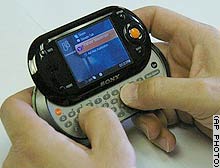
The promotional website of Mylo, under communication, makes reference to the possibility of exploring your friend’s device and “view music play lists and stream selected music files on your device”, and to add even more controversy to the allegiance of Sony to the principles of copyright law, it is two links away from a Sony website that teaches how to rip music from “records, cassettes, eight-tracks, and other formats” so you can listen it on a portable device. So, isn’t Sony part of the RIAA that says that ripping music for your portable devices is not fair use?
It is not the first time that the dual capacity of Sony, as a producer of technology that enables copyright infringement and as media owner and producer, has make it to contradict its won goals, or pursue a line with one arm that the other arm is trying to stop. The storm of the already infamous rootkit circled around privacy and spyware issues, to then turn into a copyright violation one, but, probably because the consequences could have been far more dearer for Sony, the violation to the anti circumvention measures that the sneaking of the rootkit implied were mostly overlooked. The rootkit modified the CD driver so to not allow making illegal copies of Sony CDs but, if your CD driver already had a technological protection measure the Sony rootkit would be circumventing it, making DMCA to kick in (legislation that was promoted, between others, by RIAA).
In 1984, when it was only a technology company, Sony set the standard of what companies could do without being liable for secondary infringement (do you remember the Sony Betamax case?), but after becoming a content owner and producer has been participating in almost all actions against owner and promoters of new technologies that allow copyright infringement (as for example party in MGM Studios et al. v. Grokster et al; yes Sony was part of the first et al.). Now, the problem is that after MGM v Grokster, where the US Supreme Court ruled that "one who distributes a device with the object of promoting its use to infringe copyright, as shown by clear expression or other affirmative steps taken to foster infringement, is liable for the resulting acts of infringement by third parties", both the advertisement of Mylo and other Sony's websites would not pass the test and should be found liable of inducement...
So, the Sony dilemma is about what is the main market in the future: technology innovation or content ownership? If the later is the answer, Sony may well keep defending the extreme version of copyright protection with its pals of RIAA and MPAA, but if the future lies on being in the edge of technology development Sony will have to break ranks with the content owners by showing that the current IP system does not encourage innovation and, at least in the US, runs afoul with the constitutional requirement of promoting “the Progress of Science and useful Arts”...

Friday, September 22, 2006

Welcome to the future


Sony has presented its new gadget, Mylo (My Life Online), which is bound to make a big dent in iPods and many other portable devices that are around. But of course, every new device comes with a barrage of questions about the legality of some of its features. Mylo is supposed to allow other Mylo users to check what music you have in yours, but it is not clear if it will allow for sharing it. The advertisement makes a point about this last issue, so in case of sharing being possible the second part of the Grokster test may apply...
I don't have clear if you can also use it as a normal mobile phone...

Owning the world

The best quasi science fiction video of what may be coming!

Working for who pays the bills

The recent speech by Thomas Barnett, Assistant Attorney General for the Antitrust Division of the U.S. Department of Justice, shows once again who the people in Washington are working for. There are plenty of places that show how the whole business of government has been prostituted to serve a handful of business groups that finance the election campaigns of both parties, but that a member of the U.S. Department of Justice, which has as stated purpose "[t]o enforce the law and defend the interests of the United States according to the law;... and to ensure fair and impartial administration of justice for all Americans", uses a public forum to defend the not easily defensible position of a company that he should be investigating might become the poster-child of promiscuos relations between corporations and government.
In that talk, given at the George Mason University School of Law Symposium Managing Antitrust Issues in a Global Marketplace, Mr Barnett used different arguments to attack certain legal developments outside the US that seek to curtail Apple's abuse of its dominant position in the mobile music and video market. It first laid out the economic theoretical background by using Schumpeter's characterisation of static and dynamic efficiency (efficiency based on doing the same thing but better and efficiency based on doing something new that takes the place of the old thing) and mixing it with competition and innovation to say that protecting innovation is protecting competion, to then conclude that stronger IP protection helps competition (have you heard that before. Is like encouraging sexual relations to promote virginity!). Then, the talk used examples of industries where IP and innovation helped to create excellence in the US: telephone, phonograph, light bulbs, lasers, computers, television, and pharmaceutical; it is interesting but some of these industries are between the most regulated in the world and US has not been consistent in respecting other countries' IP on them. But the substance of the speech was to defend Apple (or attack any pretension of regulating it).
It is not the first time that happens, but it is interesting to hear (actually read) again, from the mouth of a member of the US Government, the fallacious argument that the music industry lost billions due to "piracy". There is no evidence that every download displaced a legitimate purchase and the facts speak by themselvesf: in September of 2003 the RIAA filled 261 lawsuits against egregious file swappers, and one of them was Brianna LaHara, a a 12-year-old honors student who lives in a New York City Housing Authority apartment. Can anyone in its right mind think that that girl could afford to buy legally the more than 1,000 songs that she downloaded? Well, those thounsands of songs are counted as part of the music industry losses and the American government is repeating it! But the real issue was not about the music industry (but it served to show how serious and unbiased the US government analysis was): it was about the wrong-guided that the attacks on Apple were.
Apple seems to need protection from the “assault in a number of jurisdictions on the ground that iTunes is too dominant and does not “interoperate” with devices other than iPods”. The assault, Mr Barnett goes on, are based on four theories, which are rebutted by the government representative.

Theory one: consumers are locked into buying songs only from the iTunes service and they would have to pay too high a price for iTunes songs.
Mr Barnett’s rebuttal: “consumers can upload other formats to (CD-Roms and MP3 files)” to iPods (is he suggesting that is OK to infringe copyright by downloading into iPods your CD’s music?) and “while it is true that Apple’s DRM software ensures that the first recording of a song downloaded from iTunes can only play on an Apple device, consumers can re-record an iTunes song in an MP3 format and play it on other devices”. (What about the anti circumvention provisions of the DMCA?) Finally, Apple has fended off music industry’s attempt to raise prices, so that’s good for consumers…is it? The current price of 79p in UK, 99c in Ireland and 99c in the US does not reflect either the cost of delivering nor the taxation schemes of different countries. They just represent a profiteering scheme where Apple gets an alleged more than 50% of what consumers pay (so after deducting what the music industry gets you can imagine how much the actual artist receives, but that is for the third theory)

Theory two: “Apple is selling songs on the cheap but devices on the dear and consumers […] are locked into buying the same expensive devices in the future”. DOJ’s man rebuttal: “Apple’s model is the opposite: consumers buy the expensive iPod device first, then have the option- not the obligation- to use the free iTunes software and buy cheap iTunes songs”. The problem with that line of reasoning is that if you want to follow the law, buying from iTunes is not an option (the famous interoperability we were talking about before), and the songs are not cheap.

Theory three: “information wants to be free”. Mr Barnett’s rebuttal: “creators want to be paid”. But again, if artists usually get 4.5p per song, which are sold at 79p, clearly the overused line about the poor creator that needs to be paid has become more an insult to intelligence and good taste than an argument for defending stringent IP laws. It seems that the law doesn’t need to protect the creators AND Apple+music industry; it needs to protect creators FROM Apple+music industry.

Theory four: “Apple may not be hurting consumers, but it is hurting competitors”. Mr Barnett’s rebuttal: “Antitrust law protects competition, not competitors”. The first problem with this rebuttal is that Apple might well be hurting consumers, and it is more than suspicious that a member of the Antitrust Division of the US Department of Justice has chosen to “misinterpret” and misuse Brooke Group Ltd. v Brown & Williamson Tobacco Corp., where the US Supreme Court was dealing with a “conscious parallelism among oligopolists” and not with a company like Apple that has more than 80% of market share.

And then, to put the cherry on the top of the cake (was that the expression?) Mr Barnett said “if government is too willing to step in as a regulator, rivals will devote their resources to legal challenges rather than business innovation”. Was he joking? The whole IP system has been modified to benefit IP owners so they don’t care anymore about innovation and instead use a lot of resources to use their IP rights strategically in courts of law; and Apple represents some of the most egregious examples (do you remember the lawsuits of Apple against creative Labs?)
The funny side is that if an official of the equivalent of the Department of Justice of any developing country says something that goes half the way that Mr Barnett has gone, the US Deparment of State would be calling for an end of corruption, stopping the intervention in judicial matters and respect for the rule of law...

Do no evil?


There is no much discussion about the good thing that Google is for everyday's life and it is very difficult to imagine our modern life without Google. So, lets start making something very clear: Google is a great thing (this blog is provided and hosted for free by Google and most of the links are normally found using Google). But, is it still the case that the company believes the number 6 of the 10 things that has found to be true? It seems that after going public the pressures of keeping its market value rising have make a dent on Google's philosophy of doing no evil. Regardless how much spin is put around it, to try to justify censoring China's Google by saying that by doing that you are actually allowing many Chinese people to access more information is simple difficult to sustain (it looks like the market was too big for not doing some evil, what could be confirmed by the way Google snatched Dr Lee from Microsoft and offered him an unprecedented extremely generous compensation package). Then, the issue of Google library project, in which it seemed that the original ideal was to engage in a massive exercise of copyright infringement; the copyright infringement of the thumbnails of Perfect 10; the copyright infringement lawsuit from AFP; the strange arrangement with AP (which had everyone guessing due to its confidentiality); and now the problems with the Belgian court. But again, it is possible to argue that for being so innovative Google is forcing the discussion about a clear definition of fair use (although that is a concept foreign to most continental European copyright laws). Can be argued that reproducing a part of a work that could lead to the original one is not copyright infringement (as Google does and claims)? Or, on the contrary, the function of a search engine is to point to the information without showing it and, by displaying part (in the case of images it could be a substantial part) of the information there is a clear copyright violation (in some instances the information provided in the Google summary is more than the user is looking for so there is no need to go to the original? Courts are not being consistent, again, but it would be good to imagine Google as the champion of the fair use and freedom of use of information...until you remember that is the same company that threatens people who use its name as a verb...
Probaly -do no evil- sounded nice for a couple of grad students who created the most amazing tool for finding and retrieving information but has no place in the world of a mega corporation willing to own the world...

Friday, September 15, 2006

GikII 2.04

The workshop finalised with a session on Cultural Property & IT Law (2): My Game, My Rules. The fire was opened by Nicholas Gervassis with “When James T. Kirk met Buffy: Legal Facts and Fan Fiction”, where he explored what happens when devoted fans of movies, TV series or comic books go beyond the realm of exchanging views and opinions about their sphere of liking and start modifying the original work to create something that might be categorized as derivative work. Some of these fans take extreme liberties over the limits where they can push the engaged themes to, and usually without the original creator’s consent, which opens the flanks to attacks on fan-fiction due to lack of respect of the artistic integrity of legally protected materials, among others copyright violations.
Jordan Hatcher followed with “Law, Anime and Fansubs” and examined the anime industry in depth to see how the fansubs might help to achieve ripeness, broad the consumer base and increase the value of the anime’s market in certain societies, resulting in a situation where the potential damage that the anime industry could suffer due to translation and distribution of works by fans is outweighed by far by the benefits that the industry gets out of the copyright violation. It went further into analysing different instances where the industry engaged and dealt with the phenomenon, not always in the same manner (click here for Jordan's full paper).
The presentations ended in a not very glorious manner with my “The Moral Rights of the Morally Wrong: International Issues on the Commercialisation and Protection of Pornographic Japanese Manga”. The presentation first tried to explain the relation of Japanese culture and Japanese people with nudity and erotism and the historic origins of Japanese pornographic manga. It then went into how Western influence helped to shape the current Japanese manga scenario and output and the problems presented when through the posting of pornographic materials in Internet issues of copyright and obscenity arise. The problem becomes particularly acute in some regions of United States where due to the criminalisation of copyright infringement (proposed and imposed around the world by the same United States) the public resources of communities that abhor the idea of pornography of any kind might need to be used to defend the interests of those that produce pornography with a great degree of perversion (which because of being “virtual” with no real persons involved it was deemed to be protected free speech even in the case of “virtual” teen pornography).

GikII ended with a plenary session where the idea of making it an annual event was made explicit and Lilian also talked about the possibility of publishing the papers as a book. Then, to clarify what Internet is about, everyone enjoyed an example of what we were talking about.

And here is the octopus (which is an old piece of Japanese erotic art, not pornography)

GikII 2.03

After lunch, the scholars/lawyers/geeks took again their places around the table in the moot court room and then Caroline Wilson opened the session on Privacy, Identity and Code with “Online and Offline Identity: Introducing the Janus Hypothesis”. There Caroline went into using scientific and social evidence from an array of fields of knowledge to show that the online/offline context of socialization during a person’s formative years determines personal concepts of identity and the delineation of the private and public self, giving to some people greater propensity in sharing what we might call their private information. Should the law intervene to protect the privacy of a generation accustomed to be exposed? Should the self regulation be allowed knowing that we might be in front of a generation that will allow invasion to its privacy, in some cases guaranteed by law, because cannot distinguish between private/public or appreciate the importance of be left alone?
David Vaile, not showing signs of the sure tiredness due to his long trip from Australia, followed comparing the current proposal for a new Australian identity card with the previous one. The analysis was quite detailed into different aspects of both schemes and it left in the air the sensation that regardless the change of name and some minor modifications we (today we are all Australians) were facing the same old wine in a new bottle or as the Latin American (or was Spanish?) saying says, “aunque la mona se vista de seda, mona queda” (Even if the monkey dresses in silk, stays a monkey).
That part of the workshop finished with Thomas Otter and the not-fairy tale “Data Protection: The Cinderella of the software industry. The explanation revolved around the issue of software makers incorporating into code regulations decided (or to be decided) by law. In a probably reverse situation (or following its natural consequence) to regulation by code in absence of regulation by law (yes, I am talking about Lessig), Thomas analysed how industries, especially the software industry, sometimes imbed into the technology they produce the existing regulations so their product or service only delivers results that are compliant with the law. However, he observed that the software industry has failed to incorporate into code data protection principles, which make data protection the battered sister of the issues that could/should be regulated by code. As others said that day, I also think that Thomas PhD idea has a lot of potential...

Thursday, September 14, 2006

GikII 2.02

The second part of the second day started with Burkhard Shafer talk on whether the "“de minimis"” principle stands in the way of effective regulation, through his "“De minima non cura lex - an obstacle for Internet governance?" There the issue of what happens when a difference in degree within a certain class is so big that might give place to a new class, as it would be an innumerable quantity of legal acts becoming illegal due to the excessive number of them been performed at the same time. When those type of situations may seem only theoretical, the existence of Internet as a large number of interconnected networks with an always increasing number of computers connected to them create the conditions for such situations become reality. For example, the argument was made that the idea of having a server connected to an open network is to be accessed by as many people/users as possible and there is a whole science dedicated to study how to increase the number of hits on a given website. However, when a substantial number of connections is made at the same time, and usually coordinated, we might face a situation where the server stops responding to the access requests, or Denial of Service, DoS. Is a DoS attack really a misuse of a computer? Or defenseence of being doing what the server was designed for, accessing it, can/should work?
Richard Jones made a presentation on "“Spies, Slaves and Cyborgs: the technologies, architectures and cultural meanings of electronic 'tags'"”, in which criminology seemed to meet Blade Runner at the highest academic level. The talk was both entertaining and insightful, and showed to many of us that there are far many more things in the interaction of technology, law and regulation to human behavior that electronic commerce and IP.
The session ended with the thoughtful presentation of Ray Corrigan who using the application of the second law of thermodynamics to economic processes explained that the widely accepted assumption that information is non-rivalrous might not be necessary correct. His talk "“The Second Law and Rivalrous Digital Information (Or Maxwell'’s Demon in an Information Age)"” focused on the fact that once it is digitised the storage and/or transmission of information needs access to energy, and with the current and future energy situation the information's non-rivalry might well be a myth.

Thursday, September 07, 2006

GikII 2.01

After the first day and a nice dinner, GikII entered into its second and last day, and the sense that GikII was becoming a future reference point for the edges of Cyberlaw and a likely annual event was in the ambient.
The morning started with Judith Rauhofer’s “Defence against the Dark Arts: How the British Response to the Terrorist Threat is Parodied in J K Rowling’s “Harry Potter and the Half Blood Prince”. Not being a Harry Potter specialist (I’ve seen the movies but never read a book!), but having followed the comments about the books on the press, I found more than very interesting her analysis and I was nicely surprised by her study, which walks on the boundaries of socio-legal studies and literature and law. She put forward the idea that one of the reasons for the success of Harry Potter within the adult readers is the similarities between his fantastic world and recent historical and political developments. Then, she moved into explaining with very precise detail the analogies to be found in Rowling’s book 6 and the UK’s situation involving the threat of terrorism and the government activities in surveillance, detention without trial and national identity cards, to finish with the question made within the book (in different words) about whether the measure taken to protect society’s values don’t actually threat to destroy the same values they were designed to protect.
The second participant/speaker/geek was Andrew Adams, who considered the likehood of society becoming more prone to be surveillance-states as in dystopian science fiction works “From 1984 to V for Vendetta via Minority Report”. Societies are becoming more and more risk intolerant to certain kind of risk, which can lead to the expansion of actuarial approaches to justice. Can we, will we tolerate a “Big Brother” state? As in the previous talk, aren’t we/they putting forward a system that would/is/will destroy(ing) the same society that purports to defend? How we avoid it? More regulation? Self regulation? Technological resistance?
To end that session Andres Guadamuz spoke about “Killer Robots, Evil Scientists and Other Tales of Woe: How Technophobia in Culture Affects the Law”. There Andres suggested that the wrong way in which law and policy deal with technology can be informed by the fact that we live in a technofobic society and that technophobia has been created and/or reinforced by science fiction. What probably is more interesting is that those who write or make films encouraging technofobic views associate state control/bad with technology, and non-technology or more mechanical-based technology with freedom/good. The issue/contradiction is that those software or IT producers that could lead to the worst case scenario of IT controlled control-state are those who claim that lack of regulation makes us freer when it can be argued that the opposite is true and the way to avoid a control-state is by controlling the technology first, via regulation.

GikII 1.02

The coffee break was followed by the session on Copyright and the Openness Ethic in the Information Society, where Adriaan de Groot frightened the masses with his "“Open Source Killer Robots". His talk was illustrated with examples of robots, in science fiction, that due to some malfunction transformed into killer robots. The extrapolation of that to real reality and having a parallel with software in general resulted in the conclusion that having access to the source of the computer program running the robot and the source of software in general, should/would minimize the possibility of bugs that will transform a house-helper robot into a killer one. What will be the responsibility of the software programmer in case that the robot becomes a killer robot? What if the robot is using open source software? The possibility of placing liability on the software programmer/software producer (commercial ones, especially M$) was almost discarded by the subsequent discussion, mainly due to the complex nature of software, but today, looking for a parallel with an airplane (very complex machine too), where in case of failure due to a mistake in the manufacturing process the manufacturer will have at least shared liability, I am not sure that the complexity argument should be allowed to survive much longer. Clearly there is a need for further studies on the emergence of airplane industry, its liability and insurance issue compared to the situation of the software.
The session finished with Roger Burton-West explaining the work, functioning and future developments in BAILII. The idea of BAILII of reversing the trend towards the assassination of deep-linking was clearly presented and the means of doing it too. The possibility of sharing the platform to create others LII looks more than very important and we will engage in some conversations with them and AustLII, who started it all, to create LatinLII or LatLIII or LALII.

GikII 1.01

The GikII Workshop started with a session on Virtual Property and Virtual Governance, where the first shot was fired by Lilian Edwards and her "Constructing Virtual Properties: What Do Avatars, Feedback and Exploits Have in Common?". There she made a very insightful analysis of the increasing use of virtual realities for entertainment, interaction and also trade. Taking into account that there are more and more people that spend more and more time having part of their life in a world created solely by digital interaction and within those virtual worlds these people get some type of reputation, which allows them to increase the level of participation, is that reputation a property that can be traded or defended? Can you sell your eBay feedback to somebody that just arrived into the "community"? Can you transfer your reputation to other platform? What about your reputation when the owner of the platform decides to take you out of the game/virtual world/auction site? The topic is not ripe yet, but clearly will represent one of those that will give to cyberlawyers a lot to think about in the near future.
Lilian was followed by Gillian Black, who spoke about "“The Evolution of Property"”, and analyzed the question of -what is property? - from a quasi-utilitarian point of view, by saying that the concept should be understood as a social and legal instrument to protect society'’s interests and needs. The scrutinized the commercial exploitation of the persona, especially in Cyberspace, to look for the answer to the question of the ontology and law of property, and she made very valid points about taking property as a dynamic concept that evolves (or should evolve) with society and technology.
The third speaker of the day was Abbe Brown, who presented a paper titled "“Must Worlds Collide? Real and Virtual Property Worlds", where she explained the changes brought by Internet and the legal implications of the creation of virtual worlds. She addressed several questions mainly related to the interaction of real and virtual property and the relation between the possible virtual legal world and the current existing legal systems tied to geographical boundaries. Will the future bring agreements between virtual and real legal systems? Will we be able to enforce in the real world's courts what we, or our identities in avatars, have agreed in Cyberspace?
The first session finished with the presentation by Nic Suzor, who used his not very strong Australian accent to talk about "Governance in Virtual Worlds"”. Nic considered the theoretical basis for legitimate domination in virtual worlds. Since virtual worlds are based on commercial platforms, through their user agreements these companies exercise their domination as some sort of "“benign dictators". Can consensual governance be achieved in virtual worlds? Will they be feasible or legal? The other issue relevant to this topic is the interaction between real-world governments with the above-mentioned potential virtual ones. The issue of legitimacy, legality and enforcement permeates all these on-the-edge questions.
The first session ended and the sensation that something different and unique had started was in the air...

Wednesday, September 06, 2006

GikII Worshop

We are already in the first day of the VI World Computer Law Conference and we can have some reflections on the GikII that took place Monday and Tuesday, also here in Edinburgh.
It was a delighting experience to have such an impressive group of geek/lawyers and geek/computer specialists discussing about the frontiers of the law applied to cyberspace. In the words of Professor Lilian Edwards, "GikII proposes to be the place where these worlds, institutions and players will come together for the first time at a major law and technology conference. We want to discuss whether geek law exists. If you have a paper burning for the oxygen of publicity on any aspect of law AND technology, science, geek culture, blogs, popular culture, wikis, science fiction or fantasy, computer games, digital culture, gender on-line, MMORPGS, virtual property or online human personae, then this is the workshop for you. The more blue skies, the more wacky races, the more ragged bleeding edge, the less clichéd, the more challenging and contra-intuitive, the more we want it."
I hope that tonight I finally will have time to write a summary about it!

Tuesday, September 05, 2006

On the edge of Cyberlaw

We are in the second day of the GikII Workshop, held at the University of Edinburgh Law School's moot court room, and the presentations have been at the very edge of cyberlaw. The quality of the presenters have been excellent and the topics more than current (or future) and entertaining. Tonight I will try to make a summary about the whole workshop, but I really wish you were here

Monday, September 04, 2006

VI Computer Law World Conference

From tomorrow (actually today in few hours) I will be attending the VI Computer Law World Conference in Edinburgh, organized by Alfa-Redi and the AHRC Research Centre for studies in Intellectual Property and Technology Law, located in the School of Law at the University of Edinburgh. So my next postings will be with a kilt, some single malt and no cigars...

Saturday, September 02, 2006

Still no light in Internet jurisdiction

The recent US Court of Appeals for the Ninth Circuit’s ruling in Pebble Beach v. Caddy, holding that the U.S. District Court lacks personal jurisdiction over a citizen and resident of the United Kingdom (UK) who operates a passive website that a U.S. claimant (plaintiff in US terminology) asserts infringes and dilutes its trademark rights, is a new development that might seem to follow the sliding scale established in Zippo v. Zippo and further clarify the issue of assertion of personal jurisdiction over a defendant using a website, but when coupled with other recent cases reaffirms the need for the US Supreme Court to intervene in the matter. The case, where the Court of Appeal concluded that the defendant did not satisfy the test established in Calder v Jones (expressly aiming the conduct at the forum) seems to contradict Luv N' Care v. Insta Mix, an also very recent case where the US Court of Appeals for the Fifth Circuit borrowed the stream commerce theory from product liability law to find that a district court of Louisiana had personal jurisdiction over a Colorado defendant who also did not expressly aim his conduct at the forum. It might be argued that this later case does not relate to Internet (it was a copyright infringement, trademark dilution and unfair competition under the Lanham Act suit over a bottle cap) but if the stream of commerce theory can be borrowed in that case, nothing would pre-empt the use in Internet personal jurisdiction situations, and the issue is whether expressly aiming the conduct at the forum is relevant or not. Needless to say that there is no contradiction with the same court (9th Circuit) ruling in Panavision v Toeppen, where the defendant was cyber squatting with the express intent to extract money from the claimant by selling its domain name for which the claimant had a valid trademark.
The 9th Circuit Court said that it had no doubt that there was a requirement “that 'something more' than just a foreseeable effect to conclude that personal jurisdiction is proper” and that “an internet domain name and passive website alone are not 'something more' and, therefore, alone are not enough to subject a party to jurisdiction,” to then conclude that the defendant did not purposefully aim his actions at California. This seems in accordance with ALS Scan v. Digital Services Consultants but contradicts Gorman v. Ameritrade, where the US Court of Appeal for the District of Columbia Circuit found that personal jurisdiction based on a website could exist and said that cyberspace "is not some mystical incantation capable of warding off the jurisdiction of courts built from bricks and mortar."
The uncertainty seems to extend to defamation cases, where the 9th Circuit court held in Northwest Healthcare Alliance v. HealthGrades.com (unpublished) that the District Court has personal jurisdiction over an out-of-state defendant in a defamation case, based solely upon its publication of the allegedly defamatory statements in its "passive" internet web site, situation that seems to mirror the High Court of Australia’s decision in Dow Jones v. Gutnick, saying that because of publication on the Internet, the Australian courts have jurisdiction, that Australian law applies, and that the case should proceed in the trial court in the Australian state of Victoria. However, these decisions don’t suit very well with the US Court of Appeals for the Fourth Circuit opinion in Young v. New Haven Advocate, where it said that that a court in Virginia did not have jurisdiction over defendants located in Connecticut, who wrote allegedly defamatory stories about a Virginia claimant and published them on the Internet.
And…
In Carefirst Maryland v. CPC the 4th Circuit court found that the district court did not have personal jurisdiction based on the operation of a website, but in Gator.com v. L.L.Bean the 9th Circuit court found that it did have based on the same operation of a website, which added to MGM v Grokster where the US District Court of the Central District of California found that making software available for download justified personal jurisdiction

We could actually have a blog specialized in jurisdiction cases and probably most of them will contradict each other even when the opinion is given by the same court. The only way to stop this madness and the creativity of Court of Appeal’s judges when they have to justify their own contradictions will be for the US Supreme Court to finally give certiorari for one of these cases and tell us what is the law of the land.

Friday, September 01, 2006

Privacy and free speech concerns of the Convention on Cybercrime

In the beginning of August 2006 the US Senate ratified unanimously and without amendment the "Council of Europe Convention on Cybercrime", which obliges the countries that are parties to it to enact laws related to computer related crimes. The treaty also requires the parties to pass various laws related to criminal procedure, search and seizure, electronic intercepts, and data retention, that will largely add to governmental powers, which are not limited to investigation and prosecution in cybercrime cases and will apply to other criminal offences performed by the use of computers and to the collection of digital evidence, regardless the type of crime, according to its article 14.2 b and c.
But probably the most contentious features of the convention are that it requires almost automatic mutual assistance, and has no dual criminality provision, which means that a party will be obligated to compel search and seizure, data retention, and intercept assistance from a domestic service provider, at the demand of a foreign government, when the related activity is a crime in that foreign country, but legal in the requested party. For example, it will be interesting to see the reaction of the courts when a European party requests compliance with the treaty by the US when prosecuting a person accused of using a computer to disseminate hate speech that is constitutionally protected free speech in the U.S.
If the Convention is to be properly enforced, it seems that the U.S. government assertion that the convention is in full accord with all U.S. constitutional protections, such as free speech and other civil liberties and will not require the U.S. to change any of its laws does not stand the minimum analysis. However, there were some groups that found the passage of the law an occasion to celebrate. Both the Business Software Alliance and the Information Technology Association of America rejoiced and praised the SenateÂ’s approval, and probably it had a lot to do with article 10 of the Convention, which includes protection to intellectual property rights.
Parts of the treaty have been criticized by the Center for Democracy and Technology, the Electronic Privacy Information Center, and the American Civil Liberties Union for its language regarding data retention, intercepts, search and seizure and government surveillance, arguing that the treaty harms privacy rights by creating invasive investigative techniques withoutt providing privacy and civil liberties safeguards, and specifically lacking judicial review and probable cause determinations required under the US Constitution Fourth Amendment. This becomes of crucial importance after the ACLU v NSA decision of a couple of weeks ago.