Monday, April 02, 2007

Ownership of State produce works

In several conversations in different places and with different people (I especially remember one late night in Cusco) we have discussed who owns software created by an organism of the State. Can this organism require other parts of the same State to pay for its use? Or, can it deny the use altogether?

In the case of Argentina, it seems that the question is not one of copyright or contract law (as per licensing), but a pure issue of constitutional and administrative law.

If the software in question is written by a centralized organ, it is important to remember that this type of organism has no juridical personality independent from the State’s juridical personality. Then, if we take into account that to carry out their duties these organs interrelate and concentrate following rules of dependence and subordination and that they keep between them a strict relation of hierarchy with different degrees and levels, but always respecting the instructions and directives of the respective ministry, and that according to the article 103 of the Argentine Constitution the ministers cannot make resolutions on their own, with the exception of issues concerning the economic and administrative regime of their own departments, and that the article 99.1 of the same constitutional instrument de President is the political responsible for the administration of the country, copyright should be invested upon the State and the President is who exercises that right at its pleasure (although if you use this phrase in Argentina as much as it has been used here lately, you would have riots in the street).

In the case of the program being written by a decentralized organism, the titularity of the copyright would depend on the law or decree creating the organism. If a doubt exists about the faculty of such organism to claim ownership over software created within its boundaries, it needs to be remembered that “while in private law capacity is the rule, and accordingly it is presumed unless a express norm denies it, in public law the capacity of an organ is not presumed and it must be invested expressly o reasonably implicitly by law to be reputed as legally existent” (Gordillo, Tratado de Derecho Administrativo, own translation)

Unfortunately, neither Law 11.723 on the Legal Regime of Intellectual Property or its modifications make reference to intellectual property rights acquired by the State, for which it could be argued that, in absence of an express norm, the decentralized organs, as the centralized ones, do not own the copyright of the software they produce. If the idea is to find the assignment of those rights implicitly, the more general topic of the competency of the different organs and the form of resolution of competency’s conflicts could be analysed. In this case, again, the issue seem to end in the State owning the titularity of the copyright, with the only exception of the cases where a law expressly delegates it, because the competency of the organisms of the State exist only due to express delegation (Law 19.549 art 3) and in the case of conflict, this is resolved through a pyramidal and hierarchical system that has its tip the executive branch of government (Law 19.549 art 4).

In other countries the issue has been solved in many different manners. In the United Kingdom, the Works created under the orbit of the State are property of the Crown and the copyright subsists 50 years from its publication (125 years for unpublished works), according to the Copyright, Designs and Patents Act 1988. The United States has found a solution that, personally, seems more adequate. Taking into account that all works produced by the State belong to the society that the State represents and in addition they are produced using resources that belong to the society, the US Code 17 in its section 105 clearly states copyright is “not available for any work of the United States Government, but the United States Government is not precluded from receiving and holding copyrights transferred to it by assignment, bequest, or otherwise.”

Going back to the situation of Argentina, if an organism registers a work, the fact that the National Directorate for Authors Rights (a little broader than copyright) has taken the work to be registered is irrelevant; the lack of competency conditions the validity of the act but not its existence…

Tuesday, March 27, 2007

US Government risking security due to propietary software?

It may seem odd or prone to be marked as sensationalism, but the findings of the inspector general related to the US Government Integrated Wireless Network project is disturbing for several reasons. It will be others' job to discuss how serious in security and crime prevention is a government that seems to have that flag as the only still flying (all the others, regardless the spin you try to put on it, are not taken seriously anymore), but following with previous postings, this is yet another example of the problems associated to proprietary software and the use (permitted due to lack of regulation) of unfair licensing practices. One of the reasons that the inspector general's report found for the IWN project's failure, which can have negative consequences for the safety of law enforcement officers, was the fact that some of the current systems were obsolete because the manufacturers no longer supported them...Does it seem familiar? While there is nothing intrinsically wrong with proprietary software (open source is not the panacea in every situation), lack of regulation resulting in abusive practices should be a serious concern and here we have another example that even the government of the most powerful country in the planet, immersed in a so-called war on terror may put their law enforcement officials in jeopardy due to lack of support from who created its system (who probably has a new fully-supported version to offer) and we already know the legality of self-supporting proprietary software or hardware that has a technological protection measure...

Tuesday, March 06, 2007

Microsoft, the defender of IP rights


While this post adds nothing new, it is worth to keep repeating how hypocritical is Microsoft position to the protection of intellectual property rights. Now, its Associate General Counsel has started an open attack on Google relation with others' intellectual property rights, as if the Redmond company was some sort of saint in this business of respecting, or not, others' IP rights. It is important to note that the software giant main products are improvements over other people's ideas (Windows derived from Apple's graphical interface desktop environment, Word from WordStar and Word Perfect, Excel from Calc-sync and Lotus 1-2-3, and a long list of etceteras), which would have not been possible if software patents were around when Microsoft started its illustrious career and as Microsoft founder said "[i]f people had understood how patents would be granted when most of today's ideas were invented and had taken out patents, the industry would be at a complete standstill today." But once it got enough market share and money to hire attorneys, respecting IP rights and promoting software patents become some sort of holy task for Gates' company (well, unless to carry out the development of a new product needs to forget this for a while). Of course copyright is a different matter, but it seems that, again, the thrust is too use IP as a offensive weapon when the competitor has a better idea than its own, and on doing that Microsoft is really an innovator. Following Bill Gates' words "[e]stablished companies have an interest in excluding future competitors." Magister dixit...

Monday, February 26, 2007

Court from India does not buy eBay arguments


Some time ago (almost a year ago) I wrote about how ridicule was eBay's claim of being only a venue or, in the European Electronic Commerce Directive language, a mere conduit, due to be an active part of each transaction and getting a percentage of it. However, for reasons only known to judges' pillows and legislators wallets, eBay had succeeded in getting away with being the instrument used to trade counterfeited goods at monumental scale, until now. J.K. Rowling and Warner Bros have obtained an injunction from a judge in India in the action they brought in 2004 when books of Harry Potter stories were put up for sale on Baazee.com, the old name for eBay’s India operation. The analysis of the writer and publisher's lawyers as presented in The Times of London is similar to that of last year's blog, but not because I am that insightful but because it is obvious: eBay is less a mere venue than Grokster was vicariously liable and for some inexplicable reason the later was shut down and the former is thriving...

Thursday, February 22, 2007

Blogger jailed for denouncing terrorism in an Ally on the War on Terror


The Egyptian judgement condemning Abdel Karim Nabil Suleiman to 4 years of prison for expressing his opinions in his blog has received wide coverage on the international press, and it shows, again, the lack of uniformity in rules affecting freedom of expression on the net and the dubious commitment of the US government to spreading democracy. The Egyptian blogger's crime consisted of denouncing a Muslim university for promoting radical ideas, comparing the Egyptian president to the Pharaohs (for his dictatorial manners) and saying that one of the companions of the prophet Muhammad was a terrorist. While it clearly can be argued that some of those comments are offensive to some people, the right to say what people think, freely, is supposed to be an essential part of a democratic society, which the current US administration supposedly is embarked on promoting (especially in the Middle East). In order to carry out such a noble task, the American government looks for allies in different regions and one of them is Egypt. Furthermore, the blog makes some explicit references to people promoting some forms of radicalisation that leads to terrorism, and the US has kidnapped and sent people to detention facilities or to be tortured abroad for less than what Suleiman denounces.
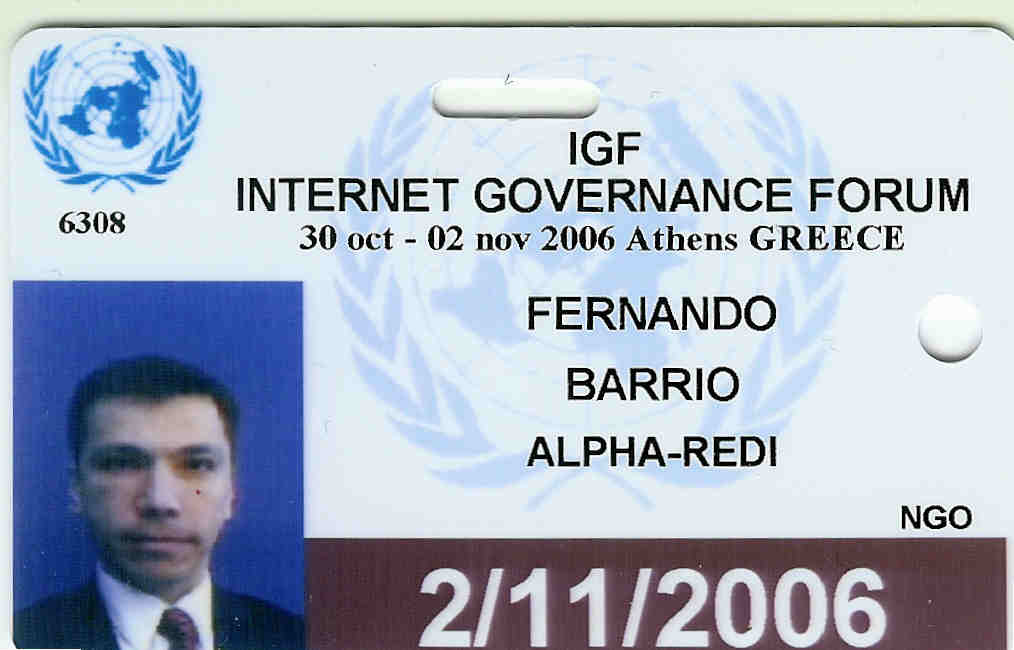
To be fair with the US Administration, the ambivalence and almost hypocrisy is not only American. During last November, at the Internet Governance Forum held in Athens, there were many voices demanding a censorship-free Internet, but it is interesting to see that some of the same voices will be probably heard in the future 4th IGF, which will take place in Egypt with Suleiman probably still in jail. Will I also forget this blog and that blogger when going to Cairo in 2009?

Wednesday, February 21, 2007

Conference of Globalization, Technology and Development


The preparations for the conference on Globalization, Technology and Development that we are organizing with Webster University and the IPSA Research Committees 4 and 35 are well under way and we have accepted 25 papers coming from 15 countries. We will have to see whether we have any cancellations, but the event promises to be an exiting one. Today Julia's given some touches to the website and soon we will have more information there (the "art" in the logo is mine, so nothing to blame on her).

Monday, February 19, 2007

Probably overblown time issue shows deeper problem

There are plenty of reports about the new "time bug" affecting computers using software produced before 2005, when the US Congress passed a law requiring that daylight-saving time should start three weeks earlier and end one week later, from 2007. So, since computers and other devices automatically correct their time by using a date that has been programmed, those devices using pre-2005's law dates would not change to daylight-saving time on, strangely enough, time. While the impact that the situation may actually have on people's lives and business' functioning is to be seen (and probably going no further than a nuisance), the implicants from the solutions are far reaching.
In order to solve the problem, if somebody is part of the alleged 97% market share that Microsoft Windows has on operating systems (2006 data), the only thing it would need to do is to download the forthcoming patch to be released tomorrow (Tuesday, February 20). However, that is only true if the user is between those using Windows XP Sever Pack 2, because for anything older Microsoft does not provide updates or patches any more, in accordance with its Support Lifecycle Policy. While it can be argued that the policy does not constitute an unfair term (it also can be argued the opposite and probably with more serious legal support) due to the life cycle of the product, the same argument contradicts completely the level of protection that software gets under different categories of intellectual property rights. Since it seems that it was Microsoft founder the one that started the comparison with the automobile, it is worth to pursue the same line and understand support and updates as a car service and repairs. Needles to say that when a security issue is discovered, the position of the software makers in general is completely untenable because the bug or mistake does not constitute, paraphrasing the law of tort, a novus actus. The damage or potential damage is caused by a mistake in the original programming and it is not the result of a change in the rules as this new time-bug seems to be (the previous paragraph does not ignore court rulings on the contrary, it just argues that those court rulings are plainly wrong and only justified by judges following the ill-conceived economic analysis of the law that incorrectly implies that it is possible to know with certainty the economic impact of a decision. Economic analysis of the law is a very interesting and useful tool for academic and policy making analysis, but too base judicial decisions on it is simply not in accordance with the legal system of most modern societies, thus wrong). However, in order to follow the car example, we can focus on supervening causes (those that were not there when the product was produced, as the example of the Congress-induced time-bug is).
There was some controversy when Microsoft first announced that it was going to stop supporting and updating old versions of Windows, and that it would have for limited time (five years) a paid service to that respect, being the strategy clearly directed to make users to upgrade to the following versions of the popular operating system. Again, it would not be very difficult to show with both legislation and case law that such a change of the original terms of the contract are not necessary legal and probably violating too many sections of consumer protection laws of too many jurisdictions, but experience has shown that the Redmond's company has enough power to convince judges and policy makers otherwise. On the other hand, and keeping with the car analogy, it can be said that when a car needs servicing or repairing the manufacturer is not expected to carry out the service or the repairs for free (unless under guarantee, but that is not compulsory and it is offered normally as a selling strategy). Thus, software producers paid-support should be normal and acceptable. However, although it is true that it might void the guarantee, there is no provision in the purchase of a car prohibiting the use of a third party mechanic. Furthermore, there is no legislation making illegal to look for such a third party solution or repair, and there is an extended and flourishing market of repair shops and third party brand parts. And that is the problem with the "lifecycle policies" for software.
It is illegal to look for a third party "repair" when the original manufacturer stops providing support and in some instances it could be even a criminal offence to do so. How can be justified to protect software with copyright that gives 95 years of protection in the US (if the copyright holder is a company) or with a patent that gives 20 years of protection when , the same companies recognize that the life cycle of the product is, at the very most (yes, is a literary licence I have taken), ten years? So it seems very explicit that the law that is supposed to "promote the progress of science and useful arts" actually only promotes monopolization and monopolistic profits, which the state is supposed to try to avoid.

Thursday, February 15, 2007

Child protection what?

The new trend of toys that can be connected to Internet, as reported by CNN.com, brings back the issue of the problems presented by the lack of broad and consistent privacy and data protection in the US. While the US keeps repeating the old and outdated discourse that self regulation is the best way of creating an e-business friendly environment, the evidence keeps suggesting that lack of consumers' confidence over the way their personal information is treated is the main factor hampering further development of e-commerce and self regulation does nothing to boost that confidence. Going back to the toys' story, most of the websites to which the kids will be directed collect personal identifiable information, and in most cases only when the kid is below 13 years old the parents' consent is required. Still, when the parents' consent is required, the reasons for which the personal identifiable data can be used are in state of flux, because the companies normally "reserve[] the right to modify [the] policy" "in order to be in compliance with the legal requirements or to provide better customer service [emphasis added]", which means whenever they want. Isn't time that in this side of the Atlantic people understand that to regulate is not to go against businesses but to ensure a more secure and predictable environment for customers and business too? I am looking forward to hearing what Veronica is going to say about this in her presentation on the Role of the State, parents and technology in the protection of children and teenagers in Internet to take place during the Globalization, Technology and Development conference here in Saint Louis next April.

Tuesday, January 30, 2007

Do no evil (for the stock holders)

It is be coming clear that the original motto of "do no evil", which the Fortune Magazine reports Google takes very seriously, is not strictly supported with facts by the company. The repetition of the fallacious argument that it is better to give censored access to Google's magnificent search technology than no access at all fails for many reason, being one very important the fact that the user will be presented with false results that show as the existing information only a part of the actual information, resulting in users believing that they have something that they actually don't thanks to censorship that Google practices on its Google.cn. It can be argued that it is actually worse when a company that praises itself of doing no harm does it big (like in this case) because it gives some sense of legitimacy to those designing the policies. So, yes, Google is doing evil, and in big form! (so, it is time to change the "Ten things that Google has found to be true" to either 9 or changing the 6th by something like "you can do evil if it makes you a lot of money")
At least that is what US Representative Chris Smith seems to understand, what has led him to re-introduce his bill that "aims to promote free expression and a free flow of information on the Internet by preventing U.S. companies from aiding regimes who restrict access to the Internet." It is also time that the rest of the members of Congress and the White House support the initiative or shut up and stop talking about freedom, democracy and all the other things they say when they want to attack a country or government.

Friday, January 19, 2007

The power of blogs or millenary ambivalence?

The Times of London reports on the furor caused by a blog written by Rui Chenggang, "who sparked [a] nationwide controversy with his blog entry 'Why Starbucks needs to get out of the Forbidden City'" (the link though is nowhere to be found). Allegedly the blog received more than a half a million visits and it seems that the audience was divided between those supporting and those opposing the anchorman's idea of taking a Western company out of the forbidden city, but most of them agreeing with the post. It is important to note that there are many others coffee shops in the forbidden city, but the blogger and director/anchor for the China Central Television seems to think that only the foreign one is misplaced because "there should be a limit to protect [their] cultural traditions". It is also important to note, that the same person has usually taken steps bridge cultural differences and misunderstandings, which makes the affirmation even more strange, taking into account that it is in the same country where the cultural revolution tried to erase the same traditions. Still, the controversy shows that blogs, even in countries that tightly control Internet, are a very powerful medium with a reach some times difficult to measure.

Thursday, January 18, 2007

December WSIS Follow up meetings of Experts

After many delays (mainly caused by relocating from London to St Louis via California), I finally decided today to write the reports on the sessions that followed the one already reported on of Expert Meeting in support of the implementation and follow-up of WSIS: Using ICTs to achieve growth and development (Jointly organized by UNCTAD, OECD and ILO). However, as soon as I started and looked for the first link I realized that it was already late and that it was not necessary. The usefulness of a blog, when informing about and event, is the possibility of putting the word out quickly and before the official transcripts have been published; after that, it would only be a way to direct traffic to the blog without much informative value. So, if you want to know what happened in Geneva in that meeting, you can go directly to the UNCTAD website where they have the Report of the Meeting, the papers and presentations, and a list of documents in several languages. So, from now on, I will go back to write about daily things and thoughts related to IT, IP, policy and development...

Sunday, December 24, 2006

Crossing the pond

From tomorrow I will be in the US taking my post as the Des Lee Visiting Lecturer for Global Awareness at Webster University and during this holiday season I plan to finally post all the relevant sessions of the WSIS follow-up meeting...

Monday, December 11, 2006

RIAA pulls its own mask off

It might sound surreal, but finally the RIAA has recognised that all the PR and lobby that has been conducting to justify stronger and longer copyrights for music have had nothing to do with rewarding authors or musicians but to augment the income of their own coffers. RIAA has made a presentation to the Copyright Royalty Board of the Library of Congress to reduce the rate the industry pay to music publishers and songwriters for the use of their creations when they record them. Is this the same RIAA that said that fair use should not be used as excuse to make profits on the "backs of hard-working creators"? I think that it is time that the word "creative" is erased from RIAA's mission statement and the real mission, "to foster a business and legal climate that supports and promotes our members' [...] financial vitality" is openly acknowledged. While it can be argued that RIAA has to protect the interests of its members, the record labels, the problem is that for almost a decade copyright law has been reformed and strengthened following the cries of RIAA to protect the "poor creators", while it seems that they are the first trying to squeeze them!

Thursday, December 07, 2006

Private copy petition

Suw Charman, from the Open Rights Group, has created a petition on 10 Downing Street's petitions website "to create a new exception to copyright law that gives individuals the right to create a private copy of copyrighted materials for their own personal use, including back-ups, archiving and shifting format." If you are a UK citizen or resident, you can go there and sign it.

Tuesday, December 05, 2006

WSIS Follow-up Session 1- Advancing the information economy

Session one started with the words of Mr. Kwaku Osofu-Adarkwa, Permanent Secretary, Ministry of Communications Ghana, who said that Ghana and Africa acknowledge the value of ICT for improving life standards, and explained that Ghana has developed an ICT for Accelerated Development Policy blueprint, which has been integrated as driver and enabler within the three-pronged Growth and Poverty Reduction Strategy II. He then referred to how Ghana’s policies are succeeding in increasing the extent of telephone lines penetration, which implied a growth of 2121% in the number of mobile phone’s subscription and 147% fixed lines phones within five years. To keep the same rate of growth and to have a modern system, the government had engaged in a process of further privatisation and deregulation of the telecommunications’ sector. Between many actions and many legislative initiatives he mentioned, he made reference to the need to proper intellectual property rights (no further definition about what proper means in this context). Then, Mr Osofu-Adarkwa referred to the need of aid to further develop the required infrastructure, specially due to the OECD and International Institutions funding having dried up. To carry out the construction of the National Communications Fibre Backbone Infrastructure network, Ghana has received money from China in the form of a China Exim Bank concessionary loan ("concessionary loan" means a loan bearing no interest or a rate of interest that is certain agreed percentage points below the average cost of borrowing in the markets). Then, he carry on explaining some rural based projects “including the development of community information centres connected to broadband infrastructure at lower cost [I assume that this refer to lower to market price] to promote ICT application in rural economic activities”. He ended by emphasising the need for harmonisation of ICT measurement and the importance of building cheap computers in developing countries, giving examples of technology parks in Ghana to that effect.
The second speaker was Dr. Bart van Ark, Professor at the University of Groningen, made a presentation about ICT as the Key to Create More Productive Jobs. He started by identifying five main points: 1) the key to accelerate economic growth is the creation of more productive jobs; 2) ICT can be an important medium in supporting productive growth; 3) an analytical and measurement framework is needed to understand how ICT contributes to growth; 4) it is the use of ICT and not the production of or the investment in ICT what generates long term impact on growth; 5) for developing and emerging economies the policy tools are the same but the emphasis may need to be changed during the process of transition. He showed some date to explain how productivity growth delivered the largest contribution to world economic growth, but less so in developing countries and that the key to narrow any given per capita income gap was to raise productivity, so the task was to produce a measurement framework to grasp ICT’s productivity contribution. Professor van Ark went on by stating that ICT impacts growths through three channels: 1st channel, effect of investment in ICT raising output and labour productivity; 2nd channel, technological change in ICT producing industries leading to Total Factor Productivity (TFP) growth; and 3rd channel, TFP growth in industries that make intensive use of ICT. The important issue is that the growth achieved through channels 1 and 2 is a one time thing, while that accomplished through channel 3 are can be permanent and to make them so is the challenge. One of the problems is that comparative growth accounts are still in the early days, but there are some moves towards the creation of world comparative growth accounts. He put forward the argument that US productivity advantage over the EU was mainly due to better use of ICT, and then showed some numbers to explain that in economies in transition the emphasis changes from labour to Total Factor Productivity contribution to GDP growth. Before giving his conclusion, Professor van Ark analysed his previous assertion that policy instruments are not different between developing and advanced countries, by explaining that technology diffusion and innovation are the key to facilitate productivity growth, that investment in R&D and human capital (knowledge and skills) are important to enhance ICT impact on productivity and value creation, and that market reforms allocate resources to their most productive uses. He concluded that ICT is key to the creation of more productive jobs.
The session ended with the presentation by Dr. Michael Jacobides, from London Business School, Advanced Institute for Management Research and Harvard Business School, who started by saying that is not ICT but what you do with ICT is what fuels productivity, and he also mentioned the need to go from countries data to firm level data. He referred to why we care about IT by stating that it changes the structure of sectors (reduce transaction costs, leading to dis-integration), it changes nature of firms (why to keep things in one roof?), it changes the nature of work (e-lance workers and a new frictionless economy), and it produces a productivity surge linked to the ability of IT to drive change. It went on to say that, however, IT alone cannot do it and it requires complementary investments. IT works when there are new practices and HR, but IT does not get adopted by all countries and sectors, so how IT affects firms to be found. He mentioned a study conducted with funding from the Leverhulme Trust, which analysed sectors dis-integration to see what IT did, analysed sectors that failed to dis-integrate despite an early hype, made a comparative analysis of sectors in different countries, and examined how firms used IT to reconfigure their structures. Their study found that, at industry level, IT as weapon not a cause, that re-thinking IT theories would save trouble and waste, and that industry that could be re-structured had dramatic gains (it was about the processes that allow evolvability). At the firm level, the study found that IT helped firms change their boundaries (effective firms gain architectural advantage), that IT-facilitated changes affect the global division of labour (easier to use IT across geographies than firms), and that firms could use IT to re-organize their own architecture. Again, he repeated that IT was not a solution but a tool, an important one. He also mentioned that their study showed that IT by itself does not drive change; it facilitates it, and only in few occasions IT was the “bottleneck”. To tackle the bottlenecks that precluded IT to fulfilling its promised a need of reorganizing firms and industries that matters was found, but the focus should be on e-volvability. Then, he addressed the question of what should be funded to assist development, and answered that it by saying that the funds did not necessarily have to go to IT in general and that there was a need to identify what IT combine with practices to generate value (for example in developing countries the emphasis should probably be on mobile phones instead of on computers). Dr. Jacobides ended by saying that funds should not be exhausted on IT.

Monday, December 04, 2006

Opening words and adoption of the agenda

The morning is over (there were very few Latin American countries, Nicaragua, Bolivia, Mexico and later Uruguay) and we are in the lunch recess. The first point of the morning was the election of officers and Mr Jaya Ratman, Deputy Permanent Representative of Singapore to the United Nations and Mr. Amr Al Jowaily, First Secretary, Permanent Mission of Egypt in Geneva, have been elected as chairperson and vice-chairperson/rapporteur respectively. The election was followed by words of the Secretary General of UNCTAD, Dr. Supachai Panitchpakdi, who, after the welcoming words of rigour, made reference to the “increasing empirical evidence of the link between the use of new information and communication technologies, growth and development.” He then referred to two diverging realities, one about the narrowing of the traditional digital divide measured in terms of Internet users, and the other the new broadband divide, which might well be relevant for business due to the need of broadband to engage in content-rich e-commerce transactions. Dr. Panitchpakdi also referred to the importance of ICT in the export sector, especially in the services sector, but all of the top 10 exporters of ICT enabled services are all developed countries, mentioning that soon China and India will make it to the top 10. To further support his claims, the UNCTAD’s Secretary General explained that “a 1% increase in a nation’s ICT index resulted on average in 0.1% increase in per capita GDP in 1996 and a 0.3% increase in 2003,” but it seemed that countries that had already reached certain level of ICT diffusion benefited most from further advancement in new technologies. So, governments can and should establish policies for building up their information societies, but measuring them would allow scrutinizing policies and that was what was needed.
His words were followed by a brief welcoming by a representative of the OECD, who spoke in the place of John Dryden, Deputy Director of STI, and mentioned the need to see whether and how ICT can benefit developing countries. She was followed by the Director of Policy Planning of the Employment Sector of ILO, Mr. Rashid Amjad, who talked about how promoting growht was about creating quality jobs, and that ILO was studying whether ICT translates into that.

Inside the WSIS-follow up meeting

I am inside the United Nations Palais des Nations E-Building at the UNCTAD Expert Meeting “In support of the implementation and follow-up of WSIS: Using ICTs to achieve growth" and development jointly organized by UNCTAD, OECD and ILO. Tonight I will post a summary of the day, a long day...

Sunday, December 03, 2006

WSIS in Geneva

From tomorrow I will be participating in the UNCTAD Expert Meeting in support of the implementation and follow-up of WSIS: Using ICTs to achieve growth and development, jointly organized by UNCTAD, OECD and ILO. It will take place at the Palais des Nations, here in Geneva, during 4 - 5 December 2006.
It is always nice to be back in Geneva. I think that the city synthesises the world and it is truly fitting that so many international organisations have their sit here. Geneva is both provincial and sophisticated, and it is as Swiss as cosmopolitan. I already made my walk across town to the Vieille-Ville and went to have a drink and a cigar to the "Demi Lune Cafe", a nice place that we discovered with Andres in May when he was here for a WIPO meeting and I came for another WSIS one. In addition, I don't know if Borges chose it to live, die and rest because it is so mystic, or the fact that Borges chose it to live, die and rest makes it so mystic...

Friday, November 24, 2006

Exemption to Prohibtion of Circumvention of Technological Protection Measures

The US Library of Congress's Copyright Office approved its Exemption to Prohibition on Circumvention of Copyright Protection Systems for Access Control Technologies, which provided with six exemptions, the most this Office has ever granted, being them focused on different groups of users. Previously, the Copyright Office took an all-or-nothing approach, making exemptions difficult to justify. The new rules take effect on 27 November 2006 and expire in three years.

The exemptions, as published by the office, are as follows:

Persons making noninfringing uses of the following six classes of works will not be subject to the prohibition against circumventing access controls (17 U.S.C. § 1201(a)(1)) during the next three years.

1. Audiovisual works included in the educational library of a college or university’s film or media studies department, when circumvention is accomplished for the purpose of making compilations of portions of those works for educational use in the classroom by media studies or film professors.

2. Computer programs and video games distributed in formats that have become obsolete and that require the original media or hardware as a condition of access, when circumvention is accomplished for the purpose of preservation or archival reproduction of published digital works by a library or archive. A format shall be considered obsolete if the machine or system necessary to render perceptible a work stored in that format is no longer manufactured or is no longer reasonably available in the commercial marketplace.

3. Computer programs protected by dongles that prevent access due to malfunction or damage and which are obsolete. A dongle shall be considered obsolete if it is no longer manufactured or if a replacement or repair is no longer reasonably available in the commercial marketplace.

4. Literary works distributed in ebook format when all existing ebook editions of the work (including digital text editions made available by authorized entities) contain access controls that prevent the enabling either of the book’s read-aloud function or of screen readers that render the text into a specialized format.

5. Computer programs in the form of firmware that enable wireless telephone handsets to connect to a wireless telephone communication network, when circumvention is accomplished for the sole purpose of lawfully connecting to a wireless telephone communication network.

6. Sound recordings, and audiovisual works associated with those sound recordings, distributed in compact disc format and protected by technological protection measures that control access to lawfully purchased works and create or exploit security flaws or vulnerabilities that compromise the security of personal computers, when circumvention is accomplished solely for the purpose of good faith testing, investigating, or correcting such security flaws or vulnerabilities.

So, it seems that some rationality is coming back to the IP Rights arena.

Tuesday, November 14, 2006

Release the Music debate

Yesterday evening, at the Conway Hall in London, took place the debate about Copyright term extension for sound recordings organized by the Open Rights Group, to which I went with students of my The Law and the Media class of the British American College of London.
The debate was preceded by a keynote talk by Professor Jonathan Zittrain, Chair in Internet Governance and Regulation at Oxford University, who gave a brief introduction about intellectual property rights in general and some insights into copyright in particular. He then, went into analysing certain aspects of copyright term extension and made reference to his participation in the failed Eldred v Ashcroft. In that point Professor Zittrain referred, again, to the requirement imposed by the US Constitution to limit the time of protection for intellectual creations (limited times was the only phrase of Article 1 Section 8 that he highlighted in red), but it can be argued that the argument then and now should be that any intellectual property right extension, both in time and coverage, should first show that promotes “the progress of Science and Useful arts”. The cases and the debates still are lost because the focus is on the wrong place: the burden should be on those proposing the extension to show that such a change will benefit society.
After a brief recess the debate started with four presentations of five minutes each, and the fire was opened by Richard Mollet, Director of Public Affairs of the BPI, who began pointing out that the campaign(s) against copyright term extension for sound recording have much of FUD themselves. He made a fair point about the ending paragraph of the “Release the Music” brief, which read that the referred extension “could sentence our cultural heritage to a commercial vacuum, preventing future artists from accessing, and being inspired by, a golden age of recorded sound”. Richard easily showed that current and future artists will access and be inspired by many songs that are under copyright and that that might always be the case. He went on with putting forward the idea that artists deserved to profits from their recordings at least during their live-times and also, making the point that the current and future knowledge economy was about intellectual property rights, there was a need to harmonize the protection terms with other countries.
His argument had an intrinsic contradiction and during the question time I tried to make that point by asking him what BPI's position really was, but even when I was the first person to raise the hand for questions it seemed that the chair never saw me, so I couldn’t. What Mr Mollet was arguing was untenable; he first kept referring to intellectual property rights as some sort of inherent right that artists had for the sole fact of being artists and that their creations were really property, ignoring that such rights exist only because the stated decided to grant them with a very specific purpose and that the “property” in intellectual property is a legal fiction designed to, by being able to transfer it and profit from it, fulfil the original purpose of benefiting society. So, if, as he said, in the 50s and 60s England lived the golden age of music without having rights to sound recording for more than 50 years, his own evidence showed that such an extension was not necessary to fulfil the social goal of encouraging creativity. If, on the other hand, he was really proposing that copyright should be a human right, well, in that case he would probably get more support, but he would be implying that BPI supports the recognition of moral rights in UK and that all those rights should cease with the dead of the artist (without even going into the impossibility of transferring many of those rights to the companies that are part of BPI). Finally, if he really meant that BPI supports full harmonization of global intellectual property rights, that would be a good news to many developing countries that were waiting to have somebody like BPI adhering to their pleas of having international recognition to an array of indigenous rights and rights over cultural heritage, which are already recognized in some developed countries as New Zealand.
The second speaker was Dave Rowntree, drummer of Blur and owner of Nanomation, who repeated his know stance pro sharing of digital music. He first recalled the series of blunders that had made the music industry not a very liked industry by the public to then correctly point out to the public interest aspects of copyright and that the interest of the recording industry were not necessarily those of the music industry. He also reaffirmed the idea that giving him more rights over the music that he had already recorded would not necessary led him to produce more music. His arguments and presence were important to show what some musicians position was in the matter but it seemed that confronted with people whose full time job were to convince people of the niceties of their companies ideas, like Richard Mollet, he would not convince many unconvinced (yesterday he was preaching to the already converted), which could be one of the reasons that Eldred v Ashcroft was lost (being right is not enough).
The third speaker was Martin Talbot, editor of Music Week, who, after acknowledging the blunders made by the recording industry (some old anti-piracy campaigns, DRM, etc), he explained why his magazine had started the campaign towards copyright extension beyond 50 years through a petition that, later explained was signed by 2000 people or members of the music industry associations (I didn’t get that very clear). His brief exposition also mentioned that it was not true that the extension was been sought only by a handful of big record companies and gave some numbers about the number of small record labels that would benefit from it. He kept referring to the concept of ownership of the creation and the rights that such a ownership should entitle, and gave some examples of people that would benefit from the proposed extension. Still, the main problem was the assumption of a legal title different from the one conferred by law. Even if the Copyright, Designs and Patents Act 1988 refers to both property right and ownership, both the courts and the doctrine have agreed that the title deserves certain qualifications, which seemed to be absent from Mr Talbot’s analysis.
The panel was closed by Caroline Wilson, lecturer at the Southampton School of Law, who, as always, delivered a solid argument explaining the lack of relation between extending the term for copyright on sound recording and the fulfilment of the objectives of copyright law, vg benefiting society. She went into some detail (as much as five minutes allowed) on the origins and principles guiding the apportion of intellectual property rights for literary and musical creations, to show why the proposed extension not only would not satisfy the mentioned objectives but it certainly contradict them. During the question time Caroline had the opportunity to rebate some of the economic analysis presented by those in favour of the extension and she ended the night by affirming, as I wanted to do, that if the BPI and the music industry was so concerned about the rights of musicians, they should support the incorporation of moral rights into UK law.
So, in conclusion, the presentations in favour of the extension had the usual sophistic analysis that lead to predetermined conclusions, but those against it still struggled with the fact that being right is not enough to win in the public arena, or in court. However, when trying to emulate the industry’s strategies, those favouring less copyright and more creativity have to be careful to not put forward statements that easily proven incorrect or be shown to be incorrect, because those in the other side are specialists in PR and public engagements, which take us back to Eldred v Ashcroft. Being right was not enough; US Supreme Court litigation needed a strategy and a skill that you cannot learn in the classroom or clerking for a US Supreme Court judge (the example can be found in the advice that the current Chief Justice of United States gave to a gay’s organization group before they appeared in the US Supreme Court).

Friday, November 10, 2006

Microsof to pay music industry per device sold


Microsoft will pay to Universal Music for each sold Zune, the portable device that the Redmond, WA, company is unveiling to compete with Apple’s iPod. The device will be lunched next Tuesday along with Zune Marketplace, a virtual music store that mimics iTunes. Apple, which has almost 80% of the portable devices’ market, pays to the music companies per sold song in iTunes, but Microsoft has agreed to, in addition of that, this payment that resembles the levy that certain devices have to pay in the USA, where the Audio Home Recording Act of 1992 introduced Section 1008 of Title 17 of the United States Code, which essentially says that it is legally to record music because a levy has been paid on the recorded media (this would bring into question the limitation for sharing that Zune has embedded.
A completely different thing is whether Zune can compete with Apple’s iPod, but as many times before, Microsoft arrives late, copy not very well at the beginning, but then catches up. One interesting feature that may rise some eyebrows, at least from the law point of view, is the possibility of sharing your music wirelessly with other Zune users...

Thursday, November 09, 2006

Performers right ruling against a supermarket in Argentina


The Civil and Commercial Court of Appeals No 1 of Cordoba, Argentina, confirmed the sentence of first instance dictated by Judge Gonzalez Zamar, who held that the supermarket chain Disco had to pay one million pesos (around U$S 300,000 or £180,000) for publicly performing music in its supermarkets without paying the respective copyright, performers rights and producers rights cannons. Following art 56 of the Intellectual Property Law No 11,723, that establishes that “[t]he performer of a literary or musical work shall be entitled to request remuneration for his performance, broadcast or retransmitted by radiotelephone, television, or recorded or printed on record, film, tape, wire or any other substance or body suitable for sound or visual reproduction”, the suit was brought by the Argentine Chamber of Producers of Phonograms and Videograms (CAPIF). What distinguishes the ruling from previous ones is the fact that is the first time that the amount of damages is calculated taking into account the number of cashiers (paying points) of the supermarket.

Wednesday, November 08, 2006

Chilean hackers jailed

Codiux, Phnx, SSH-2 and Nettoxic , the "Byond Crew chilean defacers", have been arrested by the “carabineros”, and have been accused of being part of an international group that has broken into thousands of government websites around the world. They are said to be responsible for hacking more than 8,000 sites, including some run by the governments of Argentina, Bolivia, Colombia, Peru, Turkey, the United States and Venezuela, the NASA’s site being one of them. The four hackers were members of an international group identified as the "Byond" team, a group that has been under investigation for some time with the cooperation of authorities in the United States, Israel and several South American countries. While it is clear that the four members of the Byond Crew have infiltrated thousands of sites, it is also clear that there has no been purpose of profiting but only mischief. The group has also been involved in last year’s tit-for-tat battle between Peruvian and Chilean hackers, where computer hackers brought their two countries' historic rivalries into cyberspace, posting nationalistic claims to ocean territory, seafood and the Pisco grape brandy on government Web pages.

Tuesday, November 07, 2006

Borat sparks vandalism in Kazakhstan's Wikipedia entry


The editors of the English version of Wikipedia had to limit the possibility of editing the article about Kazakhstan due to the acts of vandalism that it suffered, since the opening of the film Borat's Cultural Learnings of America for Make Benefit Glorious Nation of Kazakhstan. In some of those vandalised editions Borat was described as the president of Kazakhstan. Still, most of Wikipedia’s more than 1,471,000 articles are accurate, but issues of vandalism and inaccuracy always give arguments to those who despise it as not being a serious source of information.

Monday, November 06, 2006

5th Open Conference of GNU/Linux and Software Libre in Argentina


During the 10 and 11 of November 2006, at the Universidad Argentina de la Empresa, will take place the 5th Open Conference of GNU/Linux and Software Libre. The conference is organized by the Federal District Software Libre Users’ Group and it consists of meetings and expositions where experts and users share and debate about an array of issues involving open source software. This year’s main topic is education and within that context the First National Conference of Responsible of Computer Classrooms with Software Libre will also take place in parallel, organized by the NGO Gleducar.

Sunday, November 05, 2006

Release the Music!

The Open Rights Group organises a debate about the Copyright Term extension proposed by the content owners and a summary of the invitation is as follows:

The Open Rights Group believes that term extension is such an important issue that it deserves focused and rigourous discussion, so we’ve invited people from number of backgrounds to give us their thoughts and opinions.

We would be delighted if you could join us - the event is free to all, but places are limited so book now!

Schedule:

6.00pm - Registration.
6.30pm - Keynote by Professor Jonathan Zittrain, Chair in Internet Governance and Regulation at Oxford University.
7.30pm - Panel Discussion, moderated by John Howkins, RSA & Adelphi Charter; guests include Caroline Wilson, University of Southampton, Faculty of Law; Martin Talbot, Editor, Music Week; others TBC.
8.30pm - DJ set by The Chaps, playing a pre-1955 public domain set.
10.00pm - Close.


releasethemusic

IGF 2006 Seminario Aspectos Legales


(En castellano para que no se enoje Corina:-)


El taller sobre aspectos legales de la Gobernanza de Internet que tuvo lugar en Atenas como parte del Foro de Gobernanza de Internet 2006 tuvo un gran éxito y resalto el hecho de que, mas allÔ de los acuerdos y estÔndares técnicos, la Gobernanza de Internet se lleva a cabo a través de regulaciones, la mayoría de las cuales son implementadas en leyes. El seminario fue co-organizado por David Satola, Senior Counsel en la Vicepresidencia Legal del Banco Mundial, Alfa Redi, el Comité de Derecho del Ciberespacio de la Sección de Derecho de los Negocios de la American Bar Association, la Fundación Diplo, la Global Internet Policy Initiative, la Sociedad de Internet de Bulgaria, y la Sección de Ciencia y Tecnología de la American Bar Association.

El tema del taller fue la creación de capacidades en los aspectos legales de la Gobernanza de Internet y la relación entre el derecho internacional y domestico en dicho proceso. Luego de una pequeña introducción por parte de David Satola (aprovechando para felicitarlo y agradecerle de nuevo por la organización del taller), las ponencias empezaron con Jim Dempsey, del Center for Democracy and Technology, quien explico cuales eran las cuestiones legales asociadas con la Gobernanza de Internet y que instituciones se encontraban relacionadas con esas cuestiones a distintos niveles. Su matriz relacionando los distintos niveles de la Gobernanza de Internet, desde lo individual a lo internacional, con el status institucional de los actores fue una herramienta muy útil para entender mejor las exposiciones siguientes. Jim fue seguido por Hanne Sophie Greve, Jueza de la Corte de Apelaciones de Noruega, quien explico los conceptos bÔsicos del derecho internacional y de la legislación europea de derechos humanos, para luego relacionarlos al impacto que tienen en las regulaciones domesticas y a la necesidad de seguir esos principios al referirse tanto a la Gobernanza de Internet como a la creación de capacidades a nivel nacional relacionadas con ella. La tercera expositora fue Kristine Dorrain (National Arbitration Forum) y se refirió a la Política Uniforme de Resolución de Disputas sobre Nombres de Dominios y como impactaba la Gobernanza de Internet al nivel nacional. En su presentación uso ejemplos sobre la utilización de tal proceso y se pregunto acerca de las razones para la adopción y uso del mismo a nivel nacional. La primera parte del panel (debido al numero de expositores fue dividido en dos partes) termino con una explicación clara y concisa por parte de Fred Tipson, de Microsoft, sobre la necesidad de participación multisectorial en los procesos de desarrollo de políticas. Fue particularmente importante porque su exposición pareció hacer énfasis en dicha necesidad pero no solo para asegurar que todas las visiones e intereses estuvieran representadas, sino en el hecho de que la multisectorializacion era vital para el proceso debido a la complementariedad de especializaciones y conocimientos.

La segunda parte del panel fue iniciada por Veni Markovsky, de ISOC Bulgaria, quien explico como, siguiendo el caso de Bulgaria, la relación entre los procesos de Gobernanza de Internet nacionales e internacionales podía ser resuelta resolviendo primero las cuestiones nacionales. Durante las preguntas, Veni repitió que el caso de su país demostraba que era necesario poner primero la casa en orden antes de entablar relaciones con los vecinos y que eso podía ser alcanzado empezando desde las bases. Me toco seguir y, representando a Alfa-Redi, hice una corta presentación sobre la necesidad de incorporar los derechos de propiedad intelectual a la discusión de Gobernanza de Internet porque, aun cuando los avances en conectividad eran importantes, esos avances contrastaban con la propietización del conocimiento que había acompañado a la revolución digital. El problema, argumente, se encontraba en como el derecho internacional había sido usado para imponer cambios en las legislaciones nacionales sobre propiedad intelectual, tendiendo a la concentración de la propiedad de los contenidos, y como parecía que hasta ahora los procesos de creación de capacidades habían sido usados para domesticar a los actores nacionales en lugar de crear capacidades que permitieran diseñar sus propias reglas de acuerdo al derecho internacional (debido a la falta de tiempo, la idea original de presentar eLac 2007 fue abandonada, pero Erick Iriarte lo explico brevemente desde la sala). Siguió Peng Hwa Ang, de la Nanyang Technological University, quien explico que en Singapur, t el proceso de Gobernanza de Internet fue encarado con un enfoque desde la cúpula, lo cual había resultado en un elevado nivel de confianza y podía ser fÔcilmente relacionado con la alta tasa de penetración que Internet tiene en su país. También se refirió a los problemas generados por legislación hecha en los inicios de Internet y a la necesidad de reformas en ciertas Ôreas.
Las dos presentaciones finales tuvieron en común el tema de entrenamiento y transferencia de conocimiento como aspecto importante de la creación de capacidades en la Gobernanza de Internet.
Pierre Dandjinou, del Programa de las Naciones Unidas para el Desarrollo, se refirió al rol de las instituciones nacionales en el desarrollo de marcos regulatorios nacionales y como ciertas limitaciones podían ser superadas con promoción, entrenamiento y conocimiento compartido tanto a nivel nacional como internacional. Finalmente, Jovan Kurbalija de la Fundación Diplos) explico en detalle el proceso de creación de capacidades y como su organización abordaba el tema. Su presentación enfatizo la necesidad de crear capacidades en los distintos actores del proceso de desarrollo de políticas y la necesidad de adaptar los programas a las distintas situaciones, y también se explayo en el tema del multisectorialismo como compartimiento de especialidades mas que como defensa de intereses.

Bloggers privacy expectations and attitudes

The number of blog writers and readers has grown enormously in the last few years. Moreover, blogs are permeating most niches of social life, addressing a range of topics from scholarly and political issues to family and children's daily lives.

Blogging has the power to affect not only the lives of bloggers themselves but also of the people, companies, and products that are "blogged." For example, accounts of bloggers hurting friends' feelings or losing their jobs because of materials published on their sites are becoming more frequent. Therefore, it is important to understand how accountability and privacy expectations function in this emergent arena.

What this study is about…?

Karen Mc Cullagh is conducting an online survey to explore the privacy attitudes and expectations of bloggers as part of her PhD research, which is sponsored by the ESRC and Office of the Information Commissioner, UK.

What kinds of questions are asked…?

If you participate you will be asked to answer questions anonymously about your blogging practices and your expectations of privacy when publishing online. The survey focuses on four areas:

1. Blog content
What kind of content do bloggers publish?
Do bloggers seek permission to post photo’s of others or information about other’s lives.

2. Privacy and Identity management
Do bloggers identify themselves on their blogs?
Do bloggers identify others on their blogs?
Is identification dependent on content? (i.e., do bloggers refrain from revealing people's identities when writing about sensitive matters?)

3. Audience and control features
Do authors limit who has access to their blog posts?
Do bloggers know their readers are?

4. Privacy attitudes and expectations – legal implications

What information do people consider to be private?

What types of information do people consider to be sensitive?

Are some types of information too personal/private to publish on a blog?

Are authors getting in trouble—legally or personally—because of materials published on their blogs?

What will happen your answers...?

All answers will be stored and analysed on a confidential basis.

The responses will be used to inform academic and policy discussions on blogging practices and attitudes towards privacy.

Link to the survey:

Please take part in the survey: http://www.ccsr.ac.uk/privacysurvey/

Finally, could you please encourage other bloggers to participate in the study.

It takes less than 5 minutes to complete the survey!

Further information:

For further information on my research please visit

http://www.ccsr.ac.uk/staff/km.htm or, email:

Karen.mccullagh@postgrad.manchester.ac.uk

By their very nature, blogs raise a number of privacy issues. On the one hand, they are persistent and cumulative. At the same time, they are easy to produce and disseminate, resulting in large amounts of sometimes personal information being broadcast across the Internet

Thursday, November 02, 2006

IGF Workshop on Building Local Legal Capacity on Internet Governance


As explained in the previous post, the workshop on legal aspects of Internet Governance within the Internet Governance Forum Greece 2006 was very successful and it highlighted the fact that regardless technical and standards agreements, Internet Governance takes place through a set of regulations, most of which are implemented by laws. The seminar was jointly organized by David Satola, Senior Counsel at the Legal Vice Presidency of the World Bank, Alfa-Redi, the Cyberspace Law Committee at the Business Law Section of American Bar Association, Diplo Foundation, the Global Internet Policy Initiative, the Internet Society of Bulgaria, and the Science and Technology Law Section of the American Bar Association.
The topic of the workshop was capacity building on legal aspects of Internet Governance and the relation between international and domestic law in this process. After a brief introduction by David Satola (another congratulations and big thanks for the organization of the workshop), the presentations were started by Jim Dempsey, from the Center for Democracy and Technology, who explained what the legal issues associated with Internet Governance were and what institutions were dealing with them at different levels. His matrix relating different levels of Internet Governance, from the individual to the international, with the institutional standing of the players was a very useful tool to better understand all the following talks. He was followed by Hanne Sophie Greve, Judge of the Court of Appeal of Norway (very difficult to find public information in Norway's sites, as the Judge's link or biography), who explained the basic concepts of international law and European Human Rights law, to then relate them to their impact on domestic legal regulation and the need of following those principles when addressing both Internet Governance and the domestic capacity building related to it.
The third speaker was Kristine Dorrain (National Arbitration Forum) and she focused on the Uniform Domain-name Dispute-Resolution Policy and how it impacted Internet Governance at domestic level. Her presentation went on to show some examples of the use of that process and questioned the reasons for national level adoption and usage of them. The first part of the panel (due to the number of speakers it was divided in two parts) ended with a clear and concise explanation from Fred Tipson, Microsoft, about the need of multistakeholder participation on the policy development processes. It was important because his presentation seemed to emphasise that need, not only based on the assurance that all the views and interests were protected and taken into account, but also on the fact that “multistakeholderisation” (yes, I just made it up) was vital to the process due to complementarity of expertises and knowledge.
The second phase of the panel was opened by Veni Markovsky, from ISOC Bulgaria, who explained how, following the Bulgarian case, the relation between international and national Internet Governance processes could be solved by solving first the domestic issues. During the questions’ time, Veni repeated that his country’s case showed that it was necessary to first put the house in order before engaging with the neighbours, and that that could be achieved with a bottom-up approach. I, representing Alfa-Redi, followed with a short presentation on the need to incorporate intellectual property rights into the Internet Governance’s discussion because, even the advances in connectivity had been important, those advances contrasted the proprietization of knowledge and information accompanying the digital revolution. The problem, I argued, was located in how international norms had been used to impose changes on intellectual property domestic legislation tending to the concentration of ownership of content and how it seemed that until now capacity building had been used to domesticate domestic actors instead of to build the capacity to create its own set of rules in accordance with international law (due to time constrains, the original idea of introducing eLac 2007 was abandoned, but Erick Iriarte explained briefly about it from the floor). Peng Hwa Ang, from the Nanyang Technological University, followed explaining that in Singapore, the process of Internet Governance was addressed following a top-down approach, which resulted in a high level of trust, what can be easily related to the very high penetration rate that Internet had in his country. He also highlighted the problems of legislation being enacted too early and the need of reforms in some areas.
The two final presentations have in common the issue of coaching and knowledge transfer as important aspect of capacity building in Internet Governance. Pierre Dandjinou, of the United Nations Development Porgramme, referred to the role of national institutions in the development of national legal frameworks and how certain limitations could be overcame with advocacy, coaching and knowledge sharing at both domestic and international level. Finally, Jovan Kurbalija (Diplos Foundation) explained in detail the process of capacity building and how his organization was dealing with it. His presentation emphasised the need of capacity building for different actors of the policy making process and the necessity of tailoring programs for different situations, and expanded in the issue of “multistakeholderism” (another verbal creation) as “expertise-sharing” rather than “interest-protecting”.
As I said yesterday, it can be seen as the beginning of the beginning and I hope that we all have time to put this into paper to have soon a publication on the topic.

IGF 2006 Legal Aspects Seminar

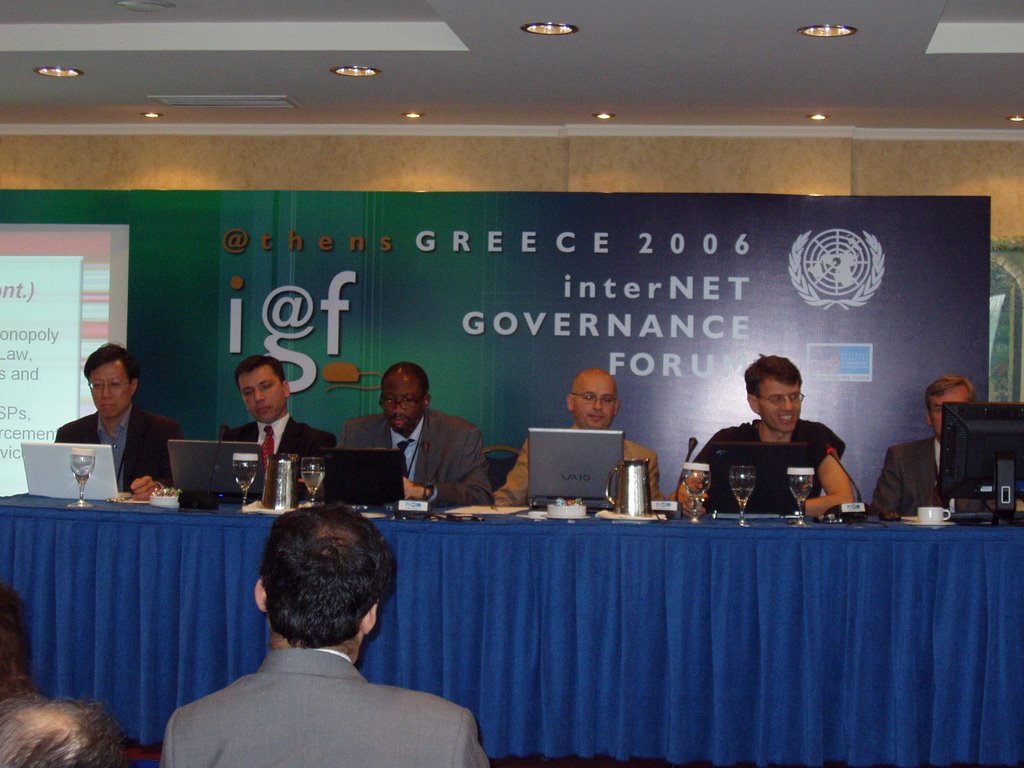
The seminar on legal aspects, organized by David Satola from the Legal Vice Presidency of the World Bank, was more than a great success. The place was literally packed and there were people standing and sitting on the floor. Then, there was also the abundance in quantity and quality of speakers: nine speakers and David as moderator (with me as being the exception in quality that confirms the rule :) It was quite clear that this morning panel's was not and end or the beginning of the end but the begining of the begining (a little misquote of Churchill, but he wouldn't mind).
Following there is a photo of the second part of the panel (and my face, second from your left, does not look swolen, it is swolen due to been bitten by a bug in Paris)

Wednesday, November 01, 2006

From the IGF in Athens

I am participating in the Internet Governance Forum in Greece, as part of the seminar on legal issues, and tonight I will post a summary of the session.

Tuesday, October 24, 2006

Call for Papers Globalization, Technology and Development


Call for papers:
Globalization, Technology and Development

The International Political Association Research Committees 04 on Public Bureaucracies in Developing Societies, 35 on Technology and Development (IPSA RC04 and RC35) and Webster University invite submission of papers for the Conference “Globalization, Technology and Development” to take place in St Louis, Missouri, USA, during 3, 4 and 5 of April 2007. This conference is part of the IPSA RC04 and RC35 Regional Meetings and the 2006/2007 Webster University Des Lee Visiting Lectureship for Global Awareness and it seeks to address the relation between globalization and technology and how their dynamic and dialectic relation impacts on development. The conference is co-chaired by Dr. Renu Khator, Provost of the South Florida University at Tampa and Chair of the IPSA RC04, Professor Dhirendra Kumar Vajpeyi, Professor of Political Science at the University of Northern Iowa and Chair of IPSA RC35, Professor Allan MacNeill, Director of the Department of Political Science and International Relations of Webster University, and Dr. Fernando Barrio, 2006/2007 Webster University Des Lee Visiting Lecturer for Global Awareness.

While the methodology is open, it is expected that the papers would be based on theoretical and empirical work leading to the development of grounded theory, as well as more policy orientated studies which feed directly into the policy making process. They would normally be built on a multi or inter-disciplinary approach.

The conference will likely include the following non-exclusive issues:

- Globalization of Intellectual Property rights, technology and development
- Globalization of technology and its impact on the Earth
- Innovation policy, technology and development
- International relations of technology transfers
- New technologies and the Digital Divide
- New technologies, communications policies and development
- Technology and human security

Submissions in the form of an abstract should be e-mailed to Dr. Fernando Barrio f.barrio@londonmet.ac.uk and it must be received by January 18th, 2007. Confirmation of acceptance will be communicated by February 9th, 2007. Papers and abstracts can be written in English, French or Spanish, but the presentations are expected to be delivered in English. Please submit your abstract of up to 300 words in .doc, .rtf or .pdf format, and include the following data:

Last name(s):
Given name(s):
Mailing address:
City:
State or Province:
Post Code:
Country:
Email address:
Affiliation:

Co-Author(s):